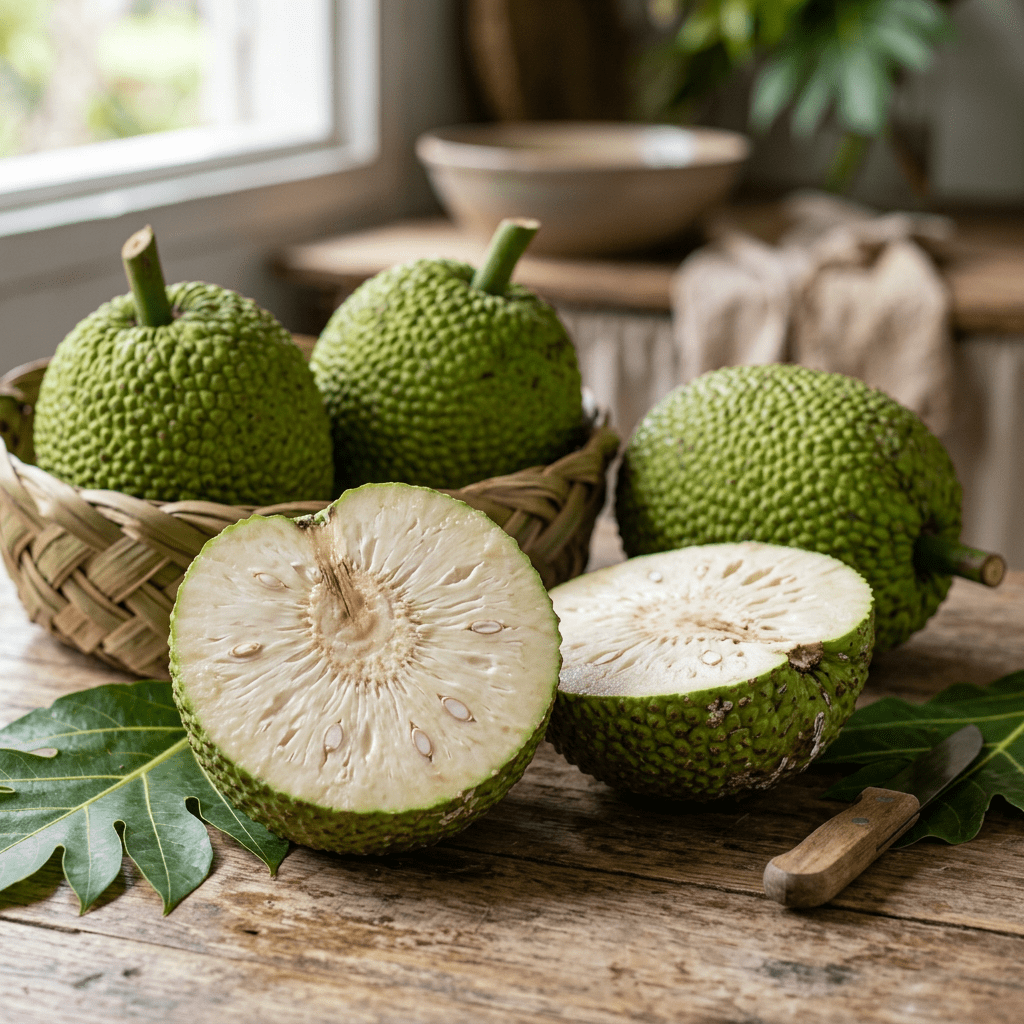
🌿 Ulu (Breadfruit): The Tree of Life
Identity & Origins
Ulu — also known as Breadfruit (Artocarpus altilis) — is one of the most beloved ancestral foods of the Pacific. Indigenous to Polynesia, Melanesia, and Micronesia, Ulu traveled across oceans in the canoes of navigators who understood its power: a tree that feeds families, stabilizes communities, and anchors entire ecosystems.
Often called “the Tree of Life,” Ulu is more than a fruit. It is a cultural inheritance, a living archive of migration, resilience, and communal nourishment.
🌱 Appearance & Botanical Profile
- Shape: Round to oval
- Skin: Green, patterned with hexagonal segments
- Texture: Firm when unripe; soft and custard-like when ripe
- Interior: Pale cream flesh, starchy, smooth, and fragrant
- Seeds: Usually seedless in cultivated varieties
Ulu grows on tall, generous trees that can produce 200+ fruits per year, making it one of the most sustainable food sources in the tropics.
🍞 Flavor Notes
Ulu’s flavor shifts with its stage of ripeness:
- Unripe: Mild, starchy, potato-like, perfect for roasting, boiling, frying, or curries.
- Ripe: Soft, slightly sweet, with a custard-like texture reminiscent of fresh bread pudding or plantain.
- Fire-roasted: Smoky, earthy, deeply comforting — the traditional way many island communities prepare it.
Ulu is a fruit that adapts to the cook, the moment, and the need.
🌺 Cultural Significance
In many traditions, planting Ulu is an act of love — a promise that no one will go hungry.
Ulu is one of the most culturally charged foods in the Pacific — a fruit that carries ancestry, migration, protection, and community within its flesh. Across Polynesia, Micronesia, and Melanesia, Ulu is not simply eaten; it is honored, planted with intention, and woven into the spiritual and social fabric of island life.
Below is a deeply expanded, ceremonial, and regionally grounded profile.
🌊 1. A Symbol of Ancestral Migration & Survival
Ulu traveled across the Pacific in the canoes of early navigators. It was chosen not only for its nourishment but for its spiritual reliability — a tree that could feed entire villages for generations.
In many traditions, Ulu represents:
- safe passage across water
- ancestral protection during migration
- the continuity of lineage
Planting Ulu was a declaration: “We will survive here. We will thrive here.”
🌱 2. The Tree of Life & Community Stability
Ulu trees can produce hundreds of fruits each year, making them a cornerstone of food security. Because of this abundance, Ulu symbolizes:
- stability
- prosperity
- collective well-being
- the responsibility to feed one another
In many villages, an Ulu tree is considered a community asset, not a private possession.
🌿 3. A Gift of Love, Marriage, and New Beginnings
Across Polynesia, gifting an Ulu sapling is a profound gesture. It is offered:
- to newly married couples
- to families welcoming a child
- to households establishing a new home
The meaning is simple and powerful: “May your home never know hunger.”
This tradition transforms Ulu into a living blessing — a tree that grows alongside the family it protects.
🔥 4. Communal Cooking & Ceremonial Feasts
Ulu is central to many communal gatherings, especially when cooked in an imu (earth oven). The process itself is ceremonial:
- men gather wood and stones
- women prepare the fruit
- elders oversee the timing
- children learn by watching
The slow, smoky cooking of Ulu becomes a ritual of togetherness — a reminder that nourishment is a shared responsibility.
🌺 5. Mythology & Sacred Stories
Many Pacific cultures hold stories of Ulu as a sacred gift.
Hawaiian Tradition
One of the most well-known legends tells of a god who sacrificed himself to feed his starving family. From his body grew:
- Ulu (breadfruit)
- Kalo (taro)
- and other staple plants
This story positions Ulu as a symbol of divine generosity and selfless love.
Samoan & Tongan Traditions
Ulu is associated with:
- hospitality
- chiefly generosity
- the responsibility of leaders to feed their people
Micronesian Traditions
Ulu is tied to:
- navigation
- ancestral guidance
- the memory of those who crossed the ocean before you
🌙 Ritual Uses of Ulu (Breadfruit)
Here are the ritual and ceremonial practices associated with Ulu across the Pacific:
1. Planting Rituals
Planting Ulu is often done with intention and prayer.
Common elements include:
- planting during a new moon for growth
- offering a small portion of food or flowers to the earth
- elders blessing the sapling
- speaking the names of ancestors
The act is seen as planting future abundance.
2. First Harvest Blessings
The first fruits of a young Ulu tree are rarely eaten casually. They may be:
- offered to elders
- shared with the entire village
- used in a ceremonial meal
- given to a family in need
This ritual reinforces the belief that abundance grows when shared.
3. Fire-Roasting as Cleansing Ritual
Roasting Ulu over open flame is more than cooking — it is a symbolic act of:
- purification
- transformation
- honoring the element of fire
In some traditions, the smoke is believed to carry prayers upward.
4. Ulu in Healing & Restorative Rituals
While not used as medicine in a clinical sense, Ulu appears in:
- postpartum nourishment rituals
- recovery meals after illness
- ceremonial foods for elders
Its grounding, starchy nature is seen as stabilizing and restorative.
5. Ulu as an Offering
In certain regions, Ulu is placed on altars or brought to community gatherings as an offering of:
- gratitude
- respect
- remembrance of ancestors
It symbolizes the cycle of giving and receiving.
🌺 Regional Variations in Cultural Meaning
Hawai‘i
Ulu is tied to:
- divine sacrifice
- family protection
- food sovereignty
- the revival of traditional agriculture
Samoa & Tonga
Ulu represents:
- chiefly generosity
- hospitality
- communal responsibility
Fiji & Melanesia
Ulu is associated with:
- seasonal rituals
- village feasts
- the honoring of elders
Micronesia
Ulu symbolizes:
- navigation
- ancestral memory
- the endurance of voyagers
🌙 Closing Cultural Reflection
Ulu is not just a fruit — it is a cultural anchor, a spiritual teacher, and a symbol of continuity. It reminds us that nourishment is communal, that abundance is meant to be shared, and that the wisdom of ancestors lives in the foods they carried across oceans.
💪 Nutrition Profile (Per 100g Cooked)
| Nutrient | Amount |
|---|---|
| Calories | ~103 kcal |
| Carbohydrates | 27 g |
| Fiber | 4.9 g |
| Protein | 1.1 g |
| Fat | 0.2 g |
| Vitamin C | 29 mg |
| Potassium | 490 mg |
| Magnesium | 25 mg |
| Folate | 14 mcg |
| Antioxidants | High |
Ulu is naturally gluten-free, rich in complex carbohydrates, and deeply sustaining.
🌿 Health Benefits
- Steady Energy: Complex carbs support long-lasting fuel without spikes.
- Digestive Support: High fiber nourishes gut health and supports regularity.
- Heart Health: Potassium and magnesium help regulate blood pressure.
- Immune Strength: Vitamin C and antioxidants protect against oxidative stress.
- Sustainable Nutrition: Ulu trees require minimal resources and support food sovereignty.
🌱 1. Sustained, Grounded Energy
Ulu is rich in complex carbohydrates, the kind that digest slowly and provide long-lasting fuel. This makes it a powerful ally for:
- steady energy throughout the day
- supporting active lifestyles
- nourishing children, elders, and anyone recovering from fatigue
Unlike refined starches, Ulu’s natural fibers help the body release energy in a gentle, stable rhythm.
🔥 2. Digestive Harmony & Gut Support
Ulu contains nearly 5 grams of fiber per 100g, offering a supportive boost for digestive wellness.
Its fiber helps:
- promote regularity
- feed beneficial gut bacteria
- support smoother digestion
- reduce the heaviness that comes from processed foods
In many Pacific households, Ulu is used as a “settling” food — something grounding when the stomach needs calm.
💓 3. Heart & Circulation Support
Ulu is naturally rich in potassium and magnesium, two minerals known to support cardiovascular balance.
These minerals help:
- maintain healthy blood pressure
- support muscle and nerve function
- encourage smooth circulation
For communities living in hot, humid climates, Ulu’s mineral profile also helps replenish electrolytes lost through sweat.
🛡️ 4. Immune Strength & Antioxidant Protection
With its Vitamin C, polyphenols, and plant antioxidants, Ulu supports the body’s natural defenses.
These compounds help:
- protect cells from oxidative stress
- support immune resilience
- reduce the impact of environmental stressors
In traditional contexts, Ulu is often paired with coconut, turmeric, or leafy greens — combinations that amplify its protective qualities.
🌬️ 5. Anti-Inflammatory Support
While not a medicinal cure, Ulu contains plant compounds that have been studied for their anti-inflammatory potential.
These may help the body:
- respond more gently to stress
- recover after physical activity
- maintain overall comfort and mobility
Island communities often describe Ulu as a “cooling” food — something that brings the body back into balance.
🧠 6. Brain & Mood Nourishment
The natural B-vitamins and slow-burning carbohydrates in Ulu help support:
- mental clarity
- stable mood
- focus and concentration
In many cultures, Ulu is served during long workdays or community gatherings because it keeps the mind steady and the body satisfied.
🌿 7. Blood Sugar Balance (When Prepared Traditionally)
When Ulu is:
- boiled
- roasted
- steamed
…it digests more slowly than fried or processed starches. This slower digestion can support more stable blood sugar responses compared to refined carbohydrates.
Traditional preparations — especially roasting over fire — preserve its natural fibers and nutrients.
🌏 8. Sustainable Wellness & Food Security
One of Ulu’s greatest “health benefits” is its impact on the health of communities and the planet.
- A single tree can produce 200+ fruits per year
- It requires minimal water
- It grows without chemical inputs
- It supports local food sovereignty
Eating Ulu is not just nourishment — it is participation in a sustainable, ancestral food system.
🌸 9. Gentle on the Body
Ulu is naturally:
- gluten-free
- low in fat
- free of additives
- easy to digest when cooked properly
This makes it a supportive option for many people seeking whole, unprocessed foods.
Ulu’s health benefits are not just nutritional — they are cultural, emotional, and communal.
It is a food that strengthens the body while reminding us of the power of rootedness, tradition, and shared nourishment.
⚠️ Who Should Not Consume Ulu (Breadfruit)
While Ulu is nourishing for most people, a few groups may need to avoid it or use caution. This section is written in the same tone as your other EJADA fruit cautions — gentle, responsible, and reader‑facing.
1. Individuals With Latex Allergies
Ulu belongs to the mulberry family, which contains natural latex. People with latex sensitivity may experience:
- itching or tingling in the mouth
- mild swelling
- digestive discomfort
Anyone with a known latex allergy should approach Ulu carefully or avoid it altogether.
2. People Sensitive to High‑Fiber Foods
Ulu is naturally high in fiber. For some individuals, especially those with:
- IBS
- chronic bloating
- slow digestion
- recent gastrointestinal upset
…large portions may cause discomfort. Smaller servings or well‑cooked preparations are often gentler.
3. Individuals Monitoring Carbohydrate Intake
Because Ulu is a starchy fruit, those following:
- low‑carb diets
- ketogenic diets
- medically supervised carb‑restricted plans
may need to limit or avoid it.
4. People With Blood Sugar Sensitivities
Ulu digests more slowly than refined starches, but it is still carbohydrate‑dense. Individuals managing:
- diabetes
- insulin resistance
- glucose sensitivity
should be mindful of portion size and preparation method (boiled or roasted is gentler than fried).
5. Those With Potassium Restrictions
Ulu contains naturally high levels of potassium. People advised to limit potassium — often due to certain kidney conditions — should avoid or strictly moderate intake.
6. Individuals With Known Allergies to Mulberry‑Family Fruits
Anyone who reacts to:
- jackfruit
- breadnut
- fig
- mulberry
may also react to Ulu due to botanical similarities.
7. Infants Under One Year Old
Because of its fiber density and starchy texture, Ulu is not recommended for babies under 12 months, unless advised by a pediatric professional.
8. People Sensitive to Wild or Fermenting Fruits
Very ripe Ulu can develop a fermented aroma. Those who are sensitive to:
- fermented foods
- strong tropical fruit scents
- overripe fruit textures
may prefer Ulu in its firmer, unripe stage.
9. Anyone Experiencing Allergic Symptoms After Eating Ulu
If someone notices:
- itching
- swelling
- hives
- digestive upset
…they should discontinue consumption and seek professional guidance.
Gentle Reminder
As with all fruits, individuals with medical conditions, dietary restrictions, or ongoing treatments should consult a healthcare provider before adding new foods to their routine.
🍽️ Culinary Uses
Ulu is one of the most versatile fruits in the world. It can be:
- Roasted whole over fire
- Boiled and mashed
- Fried into chips
- Baked into bread or pastries
- Added to soups, stews, and curries
- Turned into flour
- Used in desserts when fully ripe
It is a fruit that becomes whatever the moment calls for — savory, sweet, simple, or ceremonial.
🔥 Featured Recipe: Fire-Roasted Ulu with Coconut Cream
Ingredients
- 1 whole Ulu (breadfruit)
- 1 cup coconut cream
- Pinch of sea salt
- Optional: lime zest, chili flakes, or honey
Instructions
- Place the whole Ulu directly over an open flame or grill.
- Roast until the skin blackens and the fruit softens (about 45–60 minutes).
- Split open and scoop out the soft, smoky flesh.
- Drizzle with coconut cream and a pinch of sea salt.
- Add lime zest or chili for brightness and heat.
A dish that tastes like memory, warmth, and home.
🌺 Little‑Known Recipe: Ulu Blossom Fritters (Traditional Pacific Style)
A rare, old‑world preparation using the male Ulu blossom, lightly smoked, mashed, and fried into crisp, fragrant fritters. Traditionally served during gatherings or as a snack after harvest work.
Ulu Blossom Fritters
Prep 20 min
Cook 15 min
Serves 4
Ingredients
4–5
male Ulu blossoms (fresh or lightly dried)
1 cup
mashed cooked Ulu (or grated green Ulu)
2 tbsp
coconut cream
1
egg (optional, for binding)
1 clove
garlic, grated
1 pinch
sea salt
1–2 tbsp
finely chopped herbs (culantro, chives, or parsley)
as needed
oil for shallow frying
Instructions
1. Prepare the blossomsTrim the male Ulu blossoms and remove any tough outer fibers. Lightly roast them over an open flame or dry pan until fragrant and slightly smoky.
2. Mash and combine Finely chop the roasted blossoms and mix with mashed Ulu, coconut cream, garlic, herbs, salt, and egg if using.
3. Shape the fritters Form small patties or spoonfuls of batter. The mixture should hold together but remain soft.
4. Fry Heat a thin layer of oil in a pan and fry fritters until golden on both sides, about 2–3 minutes per side.
5. Serve Drain on cloth or paper. Serve warm with chili‑lime salt, coconut cream drizzle, or a simple herb sauce.
🌿 Why This Recipe Matters
- The male Ulu blossom is rarely used today, but in older Pacific households it was treasured for its smoky aroma and grounding energy.
- Roasting the blossom was considered a ritual of gratitude, honoring the tree for offering more than just fruit.
- These fritters were often served during:
- post‑harvest gatherings
- canoe‑building days
- communal work sessions
- or as a nourishing snack for elders
It’s a dish that carries memory, craft, and quiet ceremony.
🌞 Vitamins in Ulu (Breadfruit)
Ulu carries a quiet but powerful spectrum of vitamins — the kind that support daily strength, cellular protection, and long-term wellness. Its nutrient profile reflects the environments it comes from: sun, soil, salt air, and ancestral cultivation.
Below is a complete, expanded breakdown.
🍊 Vitamin C (Ascorbic Acid)
Ulu is naturally rich in Vitamin C, especially when lightly cooked or roasted.
Supports:
- immune resilience
- collagen formation (skin, joints, connective tissue)
- antioxidant protection
- wound healing
- iron absorption
In many island traditions, Ulu is paired with coconut or citrus to amplify this vitamin’s restorative qualities.
🧡 Vitamin A (as Beta-Carotene)
Ripe Ulu contains small but meaningful amounts of beta-carotene, a precursor to Vitamin A.
Supports:
- eye health
- skin renewal
- immune function
- cellular protection
The deeper the yellow tint inside the fruit, the higher the beta-carotene content.
💛 B‑Complex Vitamins
Ulu offers a gentle spectrum of B vitamins, especially:
B1 (Thiamine)
Supports energy metabolism and nervous system function.
B2 (Riboflavin)
Helps with cellular repair and antioxidant activity.
B3 (Niacin)
Supports skin health, digestion, and energy production.
B6 (Pyridoxine)
Important for mood regulation, brain function, and protein metabolism.
Folate (B9)
Supports cell growth, red blood cell formation, and prenatal health.
Together, these B vitamins help the body convert Ulu’s natural starches into steady, grounded energy.
🌿 Vitamin K (Small Amounts)
Ulu contains trace amounts of Vitamin K, which supports:
- bone health
- normal blood clotting
- tissue repair
While not a major source, it contributes to Ulu’s overall nutritional balance.
🌱 Vitamin E (Trace Antioxidants)
Ulu contains small amounts of Vitamin E, especially in ripe fruit.
Supports:
- skin protection
- antioxidant defense
- cellular stability
This vitamin works synergistically with Vitamin C to protect cells from oxidative stress.
✨ Summary of Key Vitamins in Ulu
| Vitamin | Role | Presence |
|---|---|---|
| Vitamin C | Immunity, collagen, antioxidant | High |
| Vitamin A (beta-carotene) | Eyes, skin, immunity | Moderate (higher in ripe fruit) |
| B1 (Thiamine) | Energy, nerves | Moderate |
| B2 (Riboflavin) | Cellular repair | Moderate |
| B3 (Niacin) | Skin, digestion | Moderate |
| B6 (Pyridoxine) | Brain, mood, metabolism | Moderate |
| Folate (B9) | Cell growth, blood health | Moderate |
| Vitamin K | Bones, clotting | Low |
| Vitamin E | Antioxidant, skin | Trace |
Ulu’s vitamin profile reflects its identity: a fruit designed to sustain, protect, and nourish. It offers not just calories, but cellular support, immune strength, and ancestral nourishment — the kind of nutrition that feels grounding, steady, and deeply human.
Sources used
National Tropical Botanical Garden – Breadfruit Institute Comprehensive research on Ulu cultivation, history, and sustainability. https://www.ntbg.org/breadfruit
USDA FoodData Central – Breadfruit Nutrition Official nutrient data for raw and cooked Ulu. https://fdc.nal.usda.gov (fdc.nal.usda.gov in Bing)
Plants Journal – Breadfruit: A Sustainable Starch for Food Security Peer‑reviewed research on Ulu’s nutritional and agricultural value. https://doi.org/10.3390/plants9091171 (doi.org in Bing)
Acta Horticulturae – Breadfruit Genetic Diversity & Ethnobotany Diane Ragone’s foundational work on Ulu varieties and cultural significance. https://doi.org/10.17660/ActaHortic.2011.918.2 (doi.org in Bing)
FAO (Food and Agriculture Organization) – Breadfruit Crop Information Global agricultural context, sustainability, and food security relevance. https://www.fao.org/3/i3820e/i3820e.pdf (fao.org in Bing)
Pacific Community (SPC) – Breadfruit in Pacific Food Systems Cultural, nutritional, and ecological role of Ulu across Pacific islands. https://www.spc.int
Hawaii Ulu Cooperative Traditional uses, recipes, cultural stories, and modern Ulu revival efforts. https://eatbreadfruit.com
University of Hawai‘i CTAHR – Breadfruit Production & Uses Agricultural guides, cultural notes, and preparation methods. https://www.ctahr.hawaii.edu
Breadfruit People – Cultural Stories & Traditional Knowledge Community‑based documentation of Ulu rituals, planting traditions, and oral histories. https://breadfruitpeople.com
🌙 Closing Remarks
Ulu reminds us that nourishment is more than a meal — it is memory, lineage, and the quiet promise that we will care for one another. This fruit carries the wisdom of voyagers, the generosity of elders, and the resilience of communities who learned to thrive with what the land offered. Whether roasted over fire, shared at a gathering, or planted as a blessing for future generations, Ulu invites us to slow down, honor our roots, and receive nourishment with gratitude.
May this fruit remind you of abundance that does not rush, strength that does not shout, and traditions that continue to feed us long after the first harvest.
⚠️ Disclaimer
The information shared here is for educational and cultural purposes only. It is not intended to diagnose, treat, cure, or prevent any medical condition. Individual nutritional needs and health considerations vary, and anyone with allergies, medical conditions, or dietary restrictions should consult a qualified healthcare professional before making changes to their diet. Ulu may not be suitable for everyone, especially individuals with latex allergies, potassium restrictions, or sensitivities to high‑fiber foods.
 EJADA
EJADA 
Leave a comment