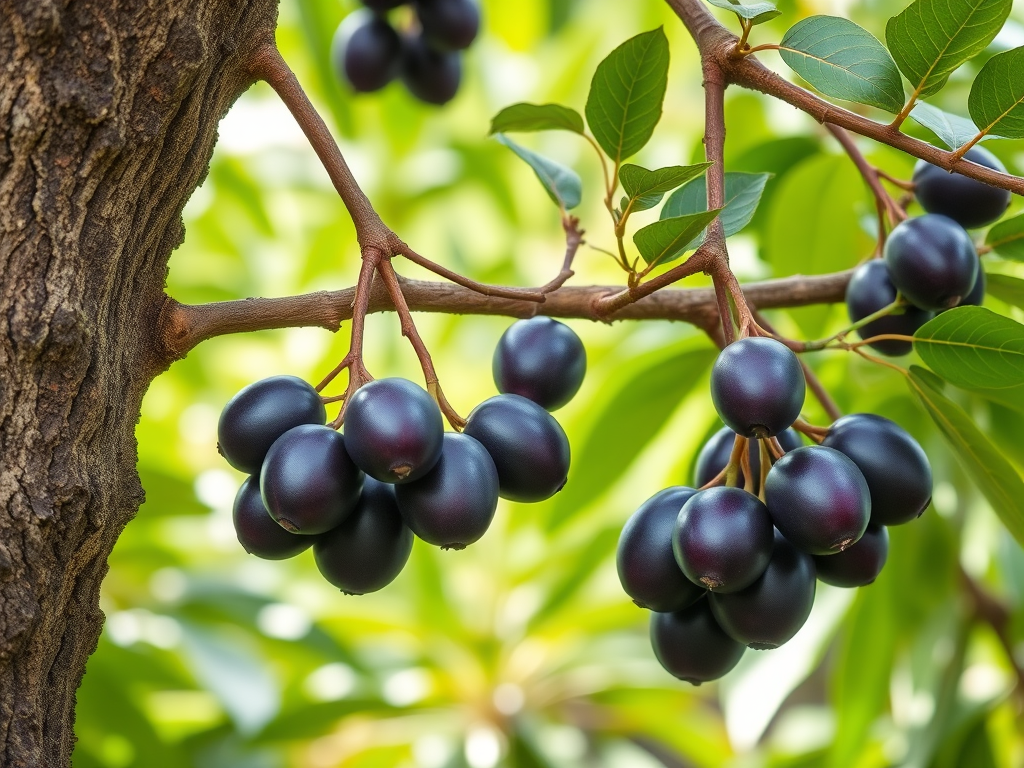
False jaboticaba is the common name for Myrciaria vexatora slow-growing evergreen tree in the myrtle family (Myrtaceae) native to Costa Rica, Panama and Venezuela.
It reaches up to 10 m tall and bears dark purple, plum-sized fruits that grow directly on the trunk and branches. The berries are larger, darker and thicker-skinned than true jaboticabas, with a sweet, mildly aromatic pulp and a single seed.
It got its name “false jaboticaba” simply because its fruit so closely resemble—and even taste like—the classic jaboticaba (Plinia spp.) yet belong to a different species. Gardeners and botanists coined the moniker to flag that while you’re getting a “jaboticaba-style” harvest, it isn’t the genuine jaboticaba you’d expect from the Plinia genus. The alternative name “blue grape tree” also nods to its grape-like berries and flavor.
There really isn’t a traditional “health‐food” cultivation of false jaboticaba (Myrciaria vexator) going back centuries—unlike its cousin the true jaboticaba, it’s always been a wild, forager’s fruit in Central and northern South America. In fact, most horticultural sources note that false jaboticaba “is not under orchard cultivation and is just a wild specimen in its native region”.
There aren’t any recorded pre-Columbian or “ancient” medicinal or ceremonial uses of the false jaboticaba (Myrciaria vexator).
Only in the last few decades—roughly since the late 1990s and early 2000s—have specialty tropical-fruit collectors and small‐scale hobbyists begun propagating it more regularly, largely driven by interest in its antioxidant-rich berries rather than any deep-rooted medicinal tradition.
Unlike its cousin the true jaboticaba—which figures in Brazilian folk remedies—the blue grape tree remained a wild, forager’s fruit in Costa Rica, Panama and Venezuela and was only formally described by botanist Rogers McVaugh in 1963.
Most of what we know today about its health kicks comes from modern phytochemical analyses, not from a handed-down herbal tradition.
Indigenous Brazilian uses of true jaboticaba – Pre-colonial harvest & naming Long before European arrival, the Tupi people knew and harvested jaboticaba—calling it jaboti-kaba (“place of tortoises,” or “fruits in a bud”)—and likely incorporated its fruit into their diet and local rituals. Early colonial naturalists’ 17th-century accounts owe much to indigenous knowledge, suggesting native groups valued both taste and medicinal properties of the tree’s berries and bark.
Traditional remedies Folk medicine across southeastern Brazil used every part of the jaboticaba tree. Fresh berries were eaten to soothe diarrhea; leaf and bark infusions treated coughs, asthma and inflammation; and poultices of mashed fruit helped heal skin lesions and ulcers. These practices rested on the fruit’s high anthocyanin and tannin levels, which confer anti-inflammatory, astringent and antimicrobial effects.
Modern applications of Myrciaria extracts in cosmetics & supplements – Skincare & haircare Myrciaria dubia (camu-camu) fruit extract appears in the EU’s CosIng database as a “skin conditioning” agent. Formulators prize it for powerful antioxidant, brightening and astringent actions—finding its way into serums, moisturizers, face masks, toners and even anti-dandruff shampoos. Clinical reports and product labels cite its ellagic acid and quercetin content for protecting skin from oxidative stress and UV-induced damage.
Nutraceuticals & immune support With up to 30× more vitamin C than oranges, camu-camu extracts are sold as powder, capsule or liquid supplements aimed at bolstering immunity, enhancing collagen synthesis and scavenging free radicals. Brands tout its combination of vitamin C, carotenoids and polyphenols for overall antioxidant defense and support of healthy aging.
 EJADA
EJADA 
Leave a comment