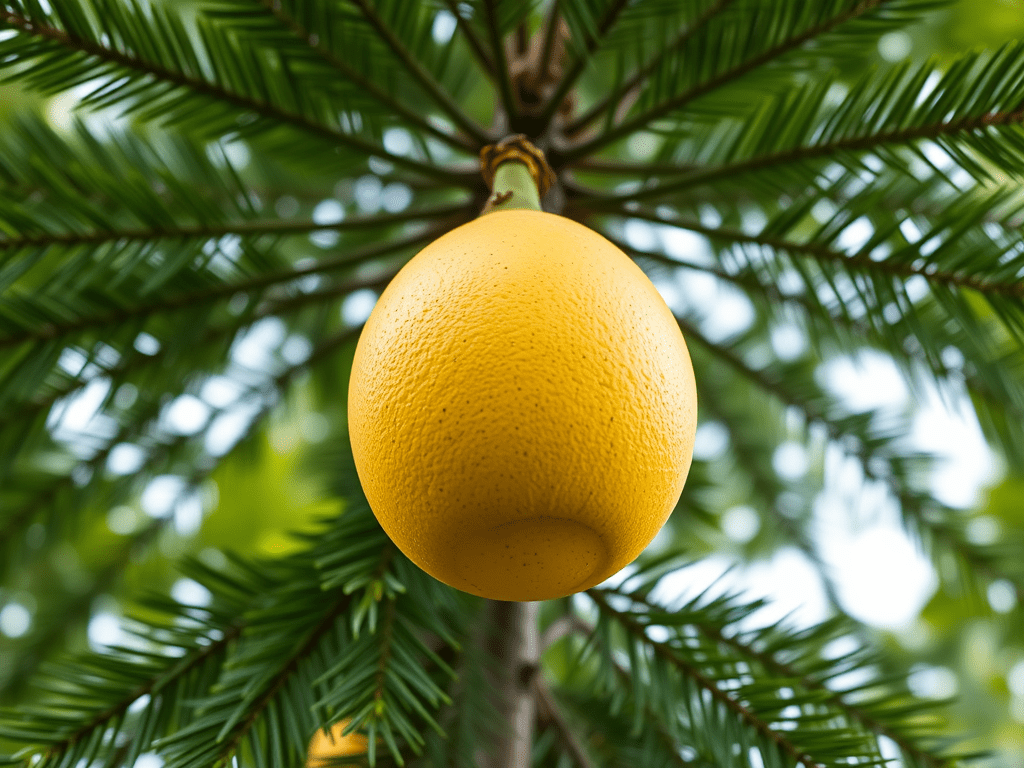
The Keule fruit is yellow when ripe, about the size of a small hen’s egg, and has a sweet, pleasant taste. It’s often used to make marmalade, desserts, and baked fruit syrups.
Interestingly, the tree is the only species in its family—Gomortegaceae—making it a botanical rarity. But here’s a quirky twist: while the fruit is edible and tasty, eating too much of it can reportedly cause a mild headache or a feeling of drunkenness. So maybe enjoy it in moderation!
The keule (Gomortega keule) was certainly known to Mapuche and other indigenous peoples of central Chile long before European contact, but it first enters the Western botanical record in the 16th–17th centuries during early Spanish explorations. Its formal scientific description came later in 1798 when Hipólito Ruiz López and José Antonio Pavón published it (as Gomortega nitida) in their Flora Peruviana et Chilensis.
Gomortega keule grows as an evergreen, pyramidal‐crowned tree typically reaching 10–15 m in height (exceptionally up to about 20 m), with trunk diameters of roughly 0.6 m at breast height.
From Day 1 it was prized above all for two things:
Its sweet, yellow drupes—eaten fresh or transformed into marmalades, desserts and fruit syrups.
Its dense, fine-grained wood—used locally for timbers and high-quality carpentry. These dual uses (food and timber) remain its primary purposes today.
Keule (Gomortega keule) is not commercially sold or widely cultivated in the United States. It’s strictly endemic to a few patches of coastal mountains in central Chile and classified as a rare, even endangered, species there—so you won’t find it in farmers’ markets, supermarket import racks, or mainstream exotic-fruit distributors.
That said, you might encounter live specimens (and very occasionally seed or scion material) in a handful of academic or botanical-garden collections here. If you’re keen to try growing it yourself, you’d need to replicate its Chilean Mediterranean-climate niche: cool, humid summers; mild, wet winters; filtered light (20–40% full sun); and well-drained, slightly acidic soil. Many enthusiasts source seed through international botanical-garden seed-exchange programs, but strict CITES-style export controls and its conservation status make legal import challenging.
Keule is the sole member of the family Gomortegaceae, a lineage over 90 million years old. Its evolutionary isolation and restricted range make it a high priority for ex-situ conservation—meaning if we lose those few Chilean wild trees, the entire family could vanish. If you’re into rare-fruit horticulture, this one sits at the apex of “botanical unicorns.”
Its yellow, fleshy drupes (3–4 cm across) bear all the hallmarks of a “megafaunal fruit” syndrome—large size, a single massive seed, oily endosperm—yet no native megaherbivores remain to eat or disperse them. Trials with modern elephants and livestock show poor germination when stones are damaged, suggesting keule’s prime dispersers were giant herbivores (gomphotheres or ground sloths) now extinct. Today its anachronic fruit traits offer a living snapshot of coevolution lost to deep time.
Botanically, keule is a linchpin for understanding magnoliid evolution and Gondwanan biogeography. As a monotypic family, it helps clarify ancestral character states in the Laurales and illuminates how isolated lineages persist in fragmented, Mediterranean-type ecosystems. Its conservation is vital not only to Chile’s endemic flora but also to preserving a branch of the angiosperm tree.
Summary of the main points about the keule fruit (Gomortega keule)
Unique Botanical Lineage: Keule is the only species in the Gomortegaceae family, a lineage dating back over 90 million years. It plays a key role in understanding magnoliid evolution and Gondwanan plant history.
Fruit and Wood Uses: The fruit is yellow, sweet, and edible—used in marmalades, desserts, and syrups. Its dense wood is prized for fine carpentry.
Ecological Rarity: Keule is endemic to a small region in central Chile and is endangered due to habitat loss, wildfires, and fragmentation. It’s not commercially available in the U.S.
Cultivation Challenges: Growing it requires conditions similar to its native Chilean habitat (mild, wet winters and well-drained, acidic soil). Conservation and legal controls restrict its distribution.
Lost Dispersers: The fruit shows traits typical of plants that once relied on extinct megafauna (e.g., giant ground sloths) for seed dispersal, making its current reproduction difficult.
Conservation Priority: Protected in national reserves like Los Queules and Los Ruiles, keule’s survival is critical to preserving a whole plant family. It’s a “botanical unicorn” for rare-plant enthusiasts.
(The species is threatened by habitat loss. The Maulino forest has mostly been cleared for agriculture and tree plantations of Pinus radiata and Eucalyptus globulus. The species’ remaining habitat is fragmented, and its populations isolated. It has been affected by fires, including the 2017 Chile wildfires. Populations are protected at Los Queules National Reserve and Los Ruiles National Reserve. https://en.wikipedia.org/wiki/Gomortega.)
 EJADA
EJADA 
Leave a comment