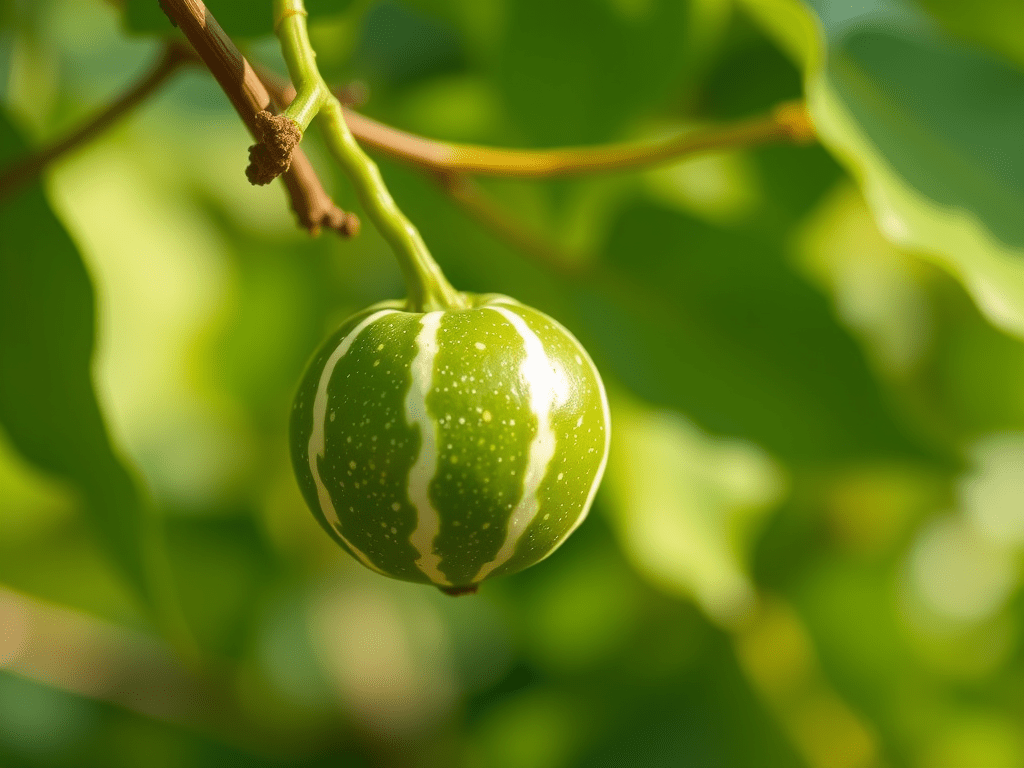
🌿 Tindora — The Little Green Wanderer
Ivy Gourd • Coccinia grandis
Some fruits arrive in the world with thunder, and some arrive with a whisper. Tindora is the whisper — a small, climbing, emerald fruit that has traveled quietly across continents, kitchens, and generations. It is the kind of fruit that doesn’t demand attention; it earns it.
In many homes across South Asia, East Africa, and the Pacific, Tindora is not just an ingredient — it is a rhythm. A daily presence. A reminder that nourishment doesn’t always come from the dramatic or the exotic; sometimes it comes from the humble, the steady, the familiar.
Tindora grows like a story that refuses to be rushed. It climbs, curls, and reaches — a vine that insists on finding its own way, much like the families who have carried it across oceans and into new soil. Its fruit, slender and green with faint white stripes, holds a crispness that feels like morning. A brightness that feels like a beginning.
🍃 Origins & Lineage
Tindora’s roots trace back to the warm landscapes of India, where it has been cultivated for centuries as both food and medicine. Over time, it traveled through trade routes into Southeast Asia, East Africa, and island nations, adapting to each climate with quiet resilience.
It is a fruit of migration — not loud, not celebrated, but deeply woven into the everyday lives of the people who carried it.
👁️ Sensory Profile
Tindora is subtle, but never dull. Its flavor sits somewhere between cucumber, zucchini, and a young melon — fresh, crisp, and lightly vegetal. When cooked, it softens into something comforting and earthy, absorbing spices like a vessel made for memory.
- Color: Bright green with pale stripes
- Texture: Firm, crisp, lightly juicy
- Flavor: Mild, refreshing, slightly tangy when young
- Aroma: Clean, green, almost rain‑washed
It is the kind of fruit that feels like a pause — a breath — a moment of clarity in the middle of a busy kitchen.
🌱 Health Benefits of Tindora
Tindora is one of those quiet fruits that carries more strength than it shows. It doesn’t arrive with bold colors or dramatic sweetness — instead, it offers a kind of steady, grounding nourishment that supports the body in ways many people overlook.
Below is a gentle, reader‑facing breakdown of its benefits, written in your EJADA tone:
🌿 1. Supports Balanced Blood Sugar
For generations, Tindora has been used in traditional systems of wellness to help the body maintain steadier glucose levels. Its natural compounds may help slow the absorption of sugar, offering a sense of internal steadiness — the kind that keeps energy from spiking and crashing.
💚 2. Rich in Antioxidants
Inside this small green fruit is a quiet army of antioxidants — plant compounds that help the body soften the effects of daily stress, pollution, and inflammation. It’s the kind of nourishment that works in the background, protecting without demanding attention.
🌾 3. Gentle Digestive Support
Tindora’s mild fiber content helps keep digestion moving with ease. It’s not harsh, not forceful — just a soft nudge toward regularity and comfort, especially when eaten lightly cooked.
🫀 4. Heart‑Friendly Nutrients
With its blend of minerals and plant compounds, Tindora supports the heart in subtle ways: helping maintain healthy cholesterol levels, easing oxidative stress, and offering the body a sense of internal calm.
🧘🏽♀️ 5. Naturally Cooling to the Body
In many traditional kitchens, Tindora is considered a cooling food — something that helps settle heat, soothe the stomach, and bring the body back into balance during warm seasons or stressful days.
🥗 6. Low‑Calorie, High‑Nourishment
Tindora is light, hydrating, and nutrient‑dense without being heavy. It’s the kind of fruit‑vegetable that fits easily into everyday meals, offering nourishment without overwhelm.
🌾 Cultural Uses & Traditional Stories
Tindora is one of those fruits that doesn’t announce itself — it simply belongs. Across India, Sri Lanka, East Africa, and parts of Southeast Asia, it shows up in kitchens the way an elder shows up in a family: quietly, consistently, and with a kind of wisdom that doesn’t need to be spoken.
A Daily Fruit With Ancestral Rhythm
In many South Asian households, Tindora is woven into the weekday rhythm — a fruit‑vegetable that appears in simple stir‑fries, spiced sautés, and comforting stews. It’s not festival food. It’s not ceremonial food. It’s everyday nourishment, the kind that holds a family together through routine and repetition.
Grandmothers often say that Tindora “keeps the body steady,” a phrase passed down long before modern nutrition tried to explain why. It’s the kind of fruit that mothers prepare for children when the weather is too hot, or when the stomach feels unsettled, or when the body needs something grounding.
A Traveler’s Fruit
Tindora traveled with people — not through conquest or trade empires, but through migration, marriage, and memory. When families moved from India to East Africa, they carried seeds in pockets, in cloth bundles, in the corners of suitcases. The vine adapted quickly, curling itself around new fences, new climates, new stories.
In Kenya and Tanzania, it became part of the local food landscape, blending into Swahili kitchens with the same quiet ease it had in Indian homes.
A Fruit of Resourcefulness
In rural communities, Tindora vines often grow wild along fences and walls. Children pick the young fruits on their way home from school, snapping them off the vine with the same casual familiarity as plucking berries.
Elders say the vine teaches a lesson: “Grow where you can. Climb toward the light. Hold on to whatever supports you.”
It’s a plant that mirrors the resilience of the people who carried it across continents.
A Symbol of Balance
In Ayurveda and other traditional systems, Tindora is considered a cooling fruit — something that brings the body back into harmony when heat, stress, or imbalance takes over. It’s often prepared lightly, with spices that warm but do not overwhelm, creating a dish that feels like equilibrium on a plate.
🍋 Vitamins & Nutrients in Tindora
Tindora may be small, but it carries a quiet concentration of nutrients — the kind that support the body in steady, everyday ways. Nothing flashy. Nothing overwhelming. Just simple nourishment that feels like it belongs in a home kitchen.
Here’s what this little green wanderer offers:
🌿 Vitamin C
A gentle boost for the immune system, skin, and daily resilience. Tindora doesn’t flood the body with Vitamin C — it offers a soft, steady amount that supports healing and cellular protection.
🌱 Vitamin A (as beta‑carotene)
Present in small but meaningful amounts, especially as the fruit ripens. Vitamin A supports vision, skin health, and the body’s natural repair processes — a quiet kind of inner strengthening.
🌾 B‑Vitamins (B1, B2, B3)
These are the “energy vitamins,” helping the body turn food into fuel. Tindora’s B‑vitamins support metabolism, nervous system balance, and gentle, sustained energy throughout the day.
🧂 Minerals: Iron, Calcium, Magnesium, Potassium
- Iron for vitality
- Calcium for bones and steady rhythms
- Magnesium for calm and muscle ease
- Potassium for hydration and heart balance
These minerals don’t shout — they simply help the body stay grounded.
🧘🏽♀️ Dietary Fiber
Soft, supportive fiber that helps digestion move with ease. It’s the kind of fiber that comforts rather than challenges the stomach.
🍃 Phytonutrients & Antioxidants
Tindora contains natural plant compounds that help the body soften inflammation, reduce oxidative stress, and maintain internal balance. These are the quiet protectors — the ones that work behind the scenes.
🍲 Culinary Uses of Tindora
Tindora is a fruit that behaves like a vegetable — a quiet shape‑shifter in the kitchen. It absorbs flavor the way a story absorbs memory: slowly, deeply, and with intention.
Across India, Sri Lanka, East Africa, and island kitchens, Tindora is used in dishes that feel like home. It’s rarely the star — but it is always the steady presence that holds the meal together.
How It’s Commonly Used
- Lightly sautéed with spices
- Stir‑fried with onions and mustard seeds
- Added to curries for texture
- Cooked with coconut for a coastal flavor
- Pickled in small batches
- Mixed into rice dishes for brightness
- Served with flatbreads as a simple, grounding meal
Tindora is the kind of ingredient that makes a dish feel complete without overwhelming it.
🥘 Recipe: Warm Spiced Tindora Sauté
A simple, nourishing dish that feels like a quiet evening in the kitchen.
Ingredients
- 2 cups fresh Tindora, sliced lengthwise
- 1 small onion, thinly sliced
- 1–2 cloves garlic, crushed
- ½ tsp mustard seeds
- ½ tsp cumin seeds
- ¼ tsp turmeric
- ½ tsp coriander powder
- Pinch of black pepper
- Salt to taste
- 1–2 tsp oil
- Optional: a handful of fresh curry leaves
- Optional: squeeze of lemon at the end
Instructions
- Warm the oil in a pan until it shimmers.
- Add mustard seeds and cumin seeds; let them crackle — this is the opening note of the dish.
- Add onions and garlic, cooking until soft and fragrant.
- Add the sliced Tindora and stir gently.
- Sprinkle turmeric, coriander, pepper, and salt.
- Cook on medium heat until the Tindora softens but still holds its shape — about 8–10 minutes.
- Finish with a squeeze of lemon or a few curry leaves for brightness.
How It Feels
This dish tastes like a pause — warm, grounding, and steady. It’s the kind of food you eat slowly, letting the spices settle into the body.
🍚 Other Simple Ways to Use Tindora
- Tindora Coconut Stir‑Fry: shredded coconut, turmeric, green chilies
- Tindora Rice: leftover rice tossed with sautéed Tindora and spices
- Tindora Pickle: tangy, spiced, and perfect with flatbreads
- Tindora & Potato Fry: a classic comfort pairing
- Tindora Curry: simmered in a tomato‑based gravy
Each variation carries the same message: simple ingredients, cooked with care, become nourishment.
🚫 Who Should Avoid Tindora
Tindora is a simple, grounding fruit‑vegetable — but like all foods, it may not be suitable for everyone. Here is a gentle, reader‑facing guide to help people make mindful choices.
🌿 1. Individuals With Sensitive Digestion
Tindora is generally mild, but for some people, especially those with very sensitive stomachs, it may cause bloating or discomfort when eaten in large amounts or when undercooked. A small portion is usually easier on the body.
🍬 2. People Monitoring Blood Sugar (Use Caution)
Tindora is traditionally used in some cultures to support balanced blood sugar. However, anyone actively managing blood sugar levels — especially those on medication — should be mindful of how new foods affect their body and consult a professional if unsure.
Tindora belongs to the same botanical family as cucumber, melon, squash, and gourds. Anyone who reacts to these foods may want to introduce Tindora slowly or avoid it altogether.
🌱 3. Those With Cucurbitaceae Sensitivities
Tindora belongs to the Cucurbitaceae family — the same botanical lineage as cucumbers, melons, squash, gourds, and pumpkins. For most people, this family is familiar and comforting. But for a small number of individuals, these plants can trigger sensitivities that show up in subtle ways.
Some people notice mild reactions when they eat foods from this family — things like itching in the mouth, digestive discomfort, or a feeling that the body is “not settling” after the meal. Others may have a known sensitivity to cucumbers or melons and may not realize that Tindora sits in the same botanical circle.
Because of this connection, anyone who has experienced discomfort with other Cucurbitaceae plants may want to approach Tindora with awareness. A small portion, eaten slowly and mindfully, is often the gentlest way to see how the body responds.
👶 4. Very Young Children
Because of its firm texture and small size, raw or lightly cooked Tindora can be a choking risk for toddlers. It’s best offered only when cut very small and fully softened — or avoided until the child is older.
🐾 5. Pets
Tindora is not considered a pet‑friendly food. It’s safest to keep it away from dogs, cats, and other animals, as their digestive systems may not tolerate it well.
⚠️ 6. Anyone Experiencing Unusual Reactions
If someone feels discomfort, nausea, or digestive upset after eating Tindora, it’s best to pause and avoid it until they understand what their body is communicating.
🌿 A Closing Reflection
Tindora may not be a fruit that turns heads, but it is one that holds stories — quiet ones, carried through kitchens, migrations, and the soft routines that shape a life. It reminds us that nourishment doesn’t always arrive with spectacle. Sometimes it comes in the form of a small green fruit, sliced lengthwise in a warm pan, filling a home with the scent of spices and memory.
In its climbing vines and steady resilience, Tindora teaches a simple truth: growth doesn’t need to be loud to be real. It can be slow, deliberate, and rooted in the everyday.
As you explore this fruit, may it invite you to honor the humble things that sustain you — the meals that ground you, the traditions that steady you, and the quiet moments that remind you of who you are becoming.
📚 Sources Used
WebMD – Ivy Gourd Overview: https://www.webmd.com/vitamins/ai/ingredientmono-1130/ivy-gourd (webmd.com in Bing) Healthline – Ivy Gourd Nutrition & Uses:
https://www.healthline.com/nutrition/ivy-gourd RxList – Coccinia Grandis Information:
https://www.rxlist.com/ivy_gourd/supplements.htm (rxlist.com in Bing) NCBI – Coccinia Grandis Research Summary:
https://www.ncbi.nlm.nih.gov/pmc/articles/PMC4027280/ (ncbi.nlm.nih.gov in Bing) Plants for a Future – Coccinia Grandis Profile:
https://pfaf.org/user/Plant.aspx?LatinName=Coccinia+grandis (pfaf.org in Bing) NutritionValue.org – Ivy Gourd Nutrient Breakdown:
https://www.nutritionvalue.org/Ivy_gourd_nutritional_value.html (nutritionvalue.org in Bing) Asian Vegetable Research Center – Ivy Gourd Notes:
https://avrdc.org Indian Council of Medical Research – Edible Plant Data:
https://www.icmr.gov.in USDA FoodData Central – Gourd Family Nutrition:
https://fdc.nal.usda.gov (fdc.nal.usda.gov in Bing) Ayurvedic Pharmacopoeia References – Traditional Uses: https://www.ayurveda.gov.in
 EJADA
EJADA 
Leave a comment