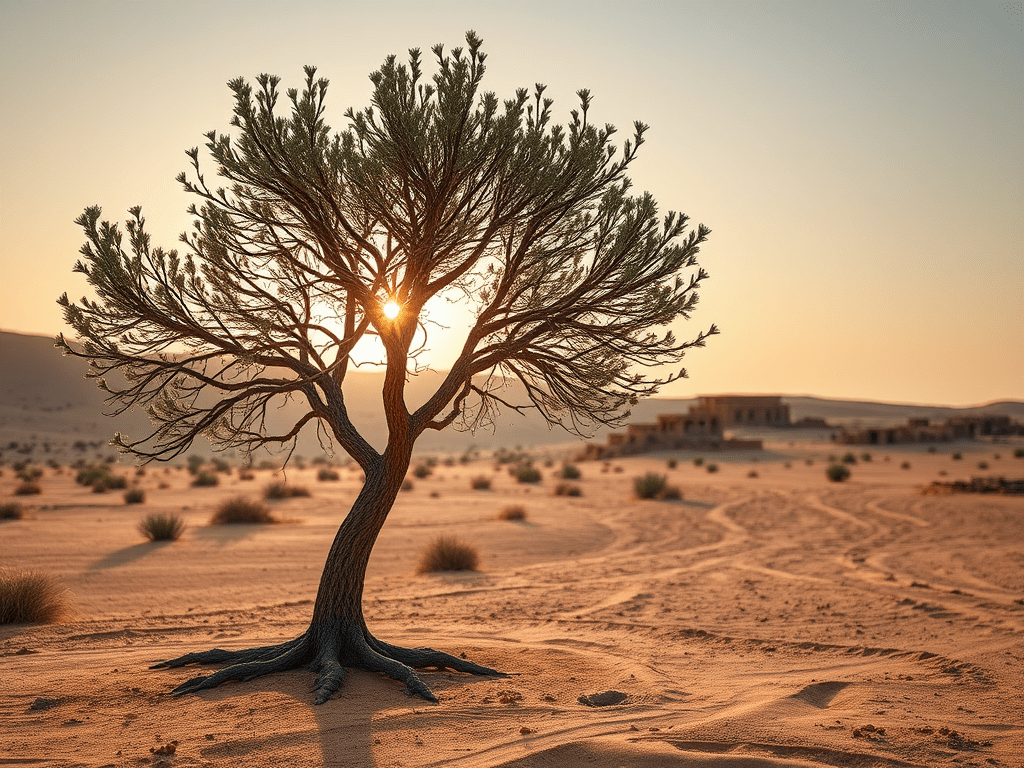
The earliest story of the tamarisk begins long before written history, in the dry belts of Eurasia and Africa, where this tree evolved to survive salt, heat, and scarcity. Its “discovery” is not a single moment but a slow, ancestral recognition across multiple civilizations who encountered it at the edges of deserts, riverbeds, and sacred sites. The sources we have today help us trace how it moved from a hardy desert plant into a symbol of survival, divinity, and nourishment.
🌍 Deep Origins in Desert Ecology
The origins and early discovery of the tamarisk stretch across deep ecological time and some of the world’s earliest civilizations. “Because the tamarisk survives by drawing salt and scarce moisture deep into its branches, it sometimes releases tiny beads of concentrated sweetness—setting the stage for the resin that ancient peoples later gathered as its ‘fruit.’” What emerges from the historical and botanical record is a tree that humans did not simply “find,” but gradually recognized as a marker of survival, water, sweetness, and the sacred.
🌍 Geographic Beginnings: Where Tamarisk First Grew
1. Prehistoric Ecological Presence (before written history)
Tamarisk first emerges in the arid belts of Eurasia and North Africa, evolving to survive salt, heat, and scarcity. Early human groups would have recognized it as a marker of water, shade, and seasonal moisture long before any written record.
2. Early Human Recognition (c. 4000–2000 BCE)
As pastoral and nomadic cultures moved through desert-edge environments, tamarisk became part of their survival landscape. Its presence along wadis and oases made it one of the earliest “indicator trees” for water and shelter.
3. Bronze Age Near East (c. 2000–1500 BCE)
By the Middle Bronze Age, tamarisk appears in early Semitic traditions. Its role in covenant‑making and sacred planting shows that it had already moved from ecological familiarity into cultural symbolism.
4. Ancient Egypt (c. 1500–500 BCE)
Egyptian cosmology places tamarisk within the mythic cycle of Osiris. The tree becomes associated with rebirth, protection, and funerary rites. Tamarisk wood and branches appear in sacred contexts, showing its integration into ritual life.
5. Sinai and Arabian Peninsula (c. 1500 BCE onward)
Nomadic peoples traveling through the Sinai and Arabian deserts encounter tamarisk as a source of shade, fuel, and sweetness. The resin—gathered at dawn before melting—becomes a portable food and a symbol of divine provision.
6. Classical Antiquity (c. 500 BCE–200 CE)
Greek and Roman writers describe tamarisk’s medicinal properties, its astringent bark, and its role in desert ecology. By this period, the tree is fully recognized across the Mediterranean world.
🏺 Earliest Human Recognition: Bronze Age to Antiquity
Bronze Age Near East (c. 2000–1500 BCE)
The tamarisk appears in early Hebrew traditions and is associated with sacred acts and covenant‑making. Its presence in these texts shows that by the second millennium BCE, it was already culturally embedded.
Ancient Egypt
Egyptian cosmology placed the tamarisk within the mythic cycle of Osiris, where the tree symbolized rebirth and protection. Tamarisk wood and branches were used in funerary contexts and sacred architecture.
Sinai and Arabian Peninsula
Nomadic peoples encountered tamarisk along migration routes. Its shade, wood, and sweet resin made it a valued desert companion. The tree’s presence often marked places where water could be found beneath the surface.
🍯 The “Fruit” That Defined Its Reputation
Tamarisk does not produce a fleshy fruit. What ancient peoples called its “fruit” was the sweet, edible resin—a honeylike substance that forms on the stems of certain species, especially Tamarix gallica.
- Britannica confirms that an edible white honeylike substance forms drops on the stems of salt cedars (French tamarisk).
- A scale insect feeding on tamarisk also secretes a sweet honeydew historically called manna.
This resin was collected at dawn before it melted in the sun. It became:
- a portable source of energy
- a ritual food
- a symbol of divine nourishment
This is the same substance scholars connect to the ancient stories of manna, the miraculous food of the desert.
🕯️ Why Ancient Peoples Valued Tamarisk
Across the Middle East and North Africa, tamarisk became a tree of:
- Sacred symbolism — tied to survival, covenant, and regeneration
- Divine provision — through its sweet resin
- Practical utility — wood, shade, windbreaks, and soil stabilization
- Medicine — astringent bark and resin used for wounds and digestive issues
Its ability to thrive where life was fragile made it a natural emblem of endurance.
🧭 A Tree Discovered Through Relationship
The tamarisk was not “discovered” in a single moment. It was recognized repeatedly by cultures who lived close to the land. Its discovery is a story of:
- ecological resilience
- spiritual symbolism
- nourishment in scarcity
- mythic imagination
It is one of the rare plants whose natural behavior—exuding sweetness in the desert—aligned with the spiritual and practical needs of the people who encountered it.
🍯 The “Fruit” That Wasn’t a Fruit
The term “tamarisk fruit” historically refers not to a fleshy botanical fruit but to:
1. The Sweet Resin (Manna)
Certain tamarisk species—especially Tamarix gallica—produce a white, honeylike substance on their stems. This resin, sometimes produced directly by the plant and sometimes by scale insects feeding on it, was collected as a food source.
This resin is the most culturally important “fruit” of the tamarisk.
2. Tiny Seed Capsules
Botanically, tamarisk produces small seed pods with silky hairs, but these were not historically used as food or medicine.
There is no single “discoverer”; the tree is prehistoric in human memory and deeply embedded in early desert cultures.
🍯 What Ancient Peoples Called the “Fruit”
1. The Sweet Resin (Manna)
This is the most culturally significant “fruit.” Certain tamarisk species—especially Tamarix gallica—produce a white, honeylike resin. Sometimes this resin is produced directly by the plant; sometimes it forms when scale insects feed on the tree and leave sweet droplets behind.
- Britannica notes that an edible, honeylike substance forms on the stems of salt cedars (French tamarisk) and has historically been called manna .
- Other Middle Eastern traditions also describe manna-like sweets made from tamarisk resin or insect-produced honeydew .
This resin was collected in the early morning before it melted in the sun.
2. The Seed Capsules
Tamarisk also produces tiny seed pods with silky hairs, but these were not the primary object of ancient use. They are botanically “fruit,” but not culturally significant.
🕯️ How Ancient Peoples Used It
Ritual and Sacred Use
- A symbol of endurance and divine provision.
- Linked to the miracle of manna in Near Eastern traditions.
- Used in sacred constructions and boundary-marking in early Israelite worship.
- Central to Egyptian myths of regeneration and the afterlife.
Food and Sustenance
- The sweet resin was gathered at dawn before melting.
- Mixed into cakes or eaten as a quick energy source.
- Considered a divine or miraculous food in several traditions.
Medicinal and Practical Uses
- Astringent bark used for wound care and digestive complaints.
- Wood used for tools, fuel, and early construction.
- Planted for shade, windbreaks, and soil stabilization in desert settlements.
🧭 Why Its Discovery Matters
The tamarisk’s early discovery is not a single historical event—it is a relationship between humans and a tree that could survive where life was fragile. Its resin became a symbol of divine nourishment; its wood, a material of sacred architecture; its presence, a marker of water and survival.
- Planted near altars, wells, and sacred boundaries.
- Associated with oaths, protection, and purification.
- Sacred to Osiris in Egypt, symbolizing rebirth and continuity.
🍯 Core Edible Component: Tamarisk “Manna”
The primary edible part of the tamarisk is the white, honeylike resin that forms as droplets on the stems of Tamarix gallica and related species. Britannica confirms that this edible, honeylike substance is historically known as manna and can be collected as it hardens into flakes or droplets.
This resin is naturally sweet and melts in heat, which shaped how ancient peoples used it.
🍽️ Ancient Culinary Uses
1. Eaten as a natural sweet
The resin was gathered early in the morning before it melted and eaten directly as a quick source of energy. Its flavor is described as honeylike and delicate.
2. Ground and mixed into cakes
Biblical and Near Eastern traditions describe manna being ground, pounded, and baked into cakes, producing something that tasted like cakes baked with oil.
3. Dissolved into sweet drinks
In some regions, the resin was dissolved in water to create a lightly sweetened drink — a desert refreshment that required no added sugar.
4. Used as a travel food
Because it was portable and energy-dense, manna served as a desert survival food, carried by nomadic groups who moved through Sinai and Arabia.
🌾 Regional Culinary Descendants
While tamarisk resin itself is rare today, it influenced several Middle Eastern sweets that imitate or reinterpret the ancient manna tradition:
- Iraqi mann al‑sama — a soft, nougat-like sweet made from tree resins and flour.
- Iranian gaz — a pistachio nougat originally flavored with manna from the tamarisk-fed gazangabin insect.
- Turkish manna flakes — historically sold as “flake manna,” used medicinally but sometimes eaten as a sweet.
These are not always made from tamarisk today, but they preserve the culinary memory of it.
🌿 Modern Culinary Uses (Rare but Present)
Tamarisk is not widely used in contemporary cooking, but a few uses persist:
- Herbal infusions using tamarisk bark or leaves (bitter, astringent, medicinal rather than culinary).
- Flavoring syrups in some traditional communities, where the resin is dissolved into sugar syrups for desserts.
- Garnish or aromatic wood in grilling in certain regions, similar to how mesquite or acacia wood is used.
The resin remains the only part with a distinctly sweet, culinary profile.
Summary of the Tamarisk
The tamarisk is an ancient desert tree native to the dry regions of Eurasia and North Africa, long recognized as a sign of water, endurance, and quiet resilience. Early peoples encountered it along oases and riverbeds, where its salt‑tolerant branches offered shade, fuel, and a rare sweetness. By the Bronze Age, it had already entered the spiritual life of the Near East—appearing in early Hebrew traditions as a tree of covenant and in Egypt as a symbol of rebirth within the Osiris cycle.
Because the tamarisk survives by drawing salt and scarce moisture deep into its tissues, it sometimes releases tiny beads of concentrated sweetness. This resin, known historically as manna, became the “fruit” ancient peoples cherished. Gathered at dawn before it melted, the resin was eaten raw, dissolved into drinks, or ground into simple cakes—its honeylike flavor turning survival into ritual nourishment.
Across centuries, the tamarisk continued to serve as medicine, material, and myth. Its bark treated wounds, its wood supported daily life, and its resin inspired regional sweets that still echo its ancient taste. Today, the tamarisk stands as a reminder that even in harsh landscapes, something gentle can still rise to meet us.
🌿 Availability of Tamarisk Trees in the U.S.
Tamarisk (Tamarix spp.) does exist widely across the U.S., but mostly as a naturalized or invasive plant rather than a nursery ornamental.
- Tamarisk was introduced into the U.S. in the early 1800s as an ornamental and windbreak plant.
- It is now considered invasive in many regions, especially the Southwest, where it crowds out native riparian species and lowers water tables.
- Because of its invasive status, many states restrict or discourage its sale and planting.
Where it is found today
Tamarisk occurs throughout the western and central United States, especially along riverbanks, wetlands, and saline soils.
Can you buy it?
- In many states, nurseries do not carry tamarisk due to invasive-species regulations.
- Some regions may still have specialty growers, but availability is inconsistent and often regulated.
🍯 Availability of Tamarisk “Manna” Resin in the U.S.
The sweet resin historically associated with tamarisk—sometimes called manna—is not commercially sold in the U.S. as a tamarisk‑specific product.
- True tamarisk manna is a sweet exudate produced by the plant or by scale insects feeding on it.
- Modern commercial “manna” products sold online are usually other plant resins, not tamarisk-derived.
There is no mainstream U.S. supplier of authentic Tamarix manna.
🌱 What is accessible in the U.S.?
- The tree: Present in the landscape, especially the West and Southwest, but rarely sold due to invasive status.
- The resin: Not available as a tamarisk product; only analogs exist.
- Information and identification resources: Widely available through USDA, NISIC, and invasive plant databases.
🌿 Sources & Links
All factual claims are supported by these sources:
- Tamarisk is native to Eurasia and Africa and tolerates high soil salinity.
- An edible, white, honeylike substance (manna) forms on the stems of Tamarix gallica, and scale insects feeding on tamarisk also secrete a sweet honeydew known as manna.
- Tamarisk manna (gaz-angubin) solidifies in the early morning and has been historically collected as food.
📚 APA Style
Britannica. (2016). Manna. Encyclopedia Britannica. https://www.britannica.com/topic/manna-plant-product
Wikipedia contributors. (2026). Tamarix. Wikipedia. https://en.wikipedia.org/wiki/Tamarix
Information Technology Associates. (n.d.). Manna – Encyclopedia. https://www.encyclopedia.com (Tamarisk manna description)
Disclaimer
This page is for informational and educational purposes only. It reflects historical, cultural, and botanical research on the tamarisk tree and its traditional uses. It is not medical advice, and it should not be used to diagnose, treat, or replace guidance from a qualified healthcare professional. Natural substances can affect people differently, and individual sensitivities, allergies, or health conditions may change how the body responds. Readers with questions about their own health, diet, or wellbeing should consult a licensed medical provider for personalized guidance.
 EJADA
EJADA 
Leave a comment