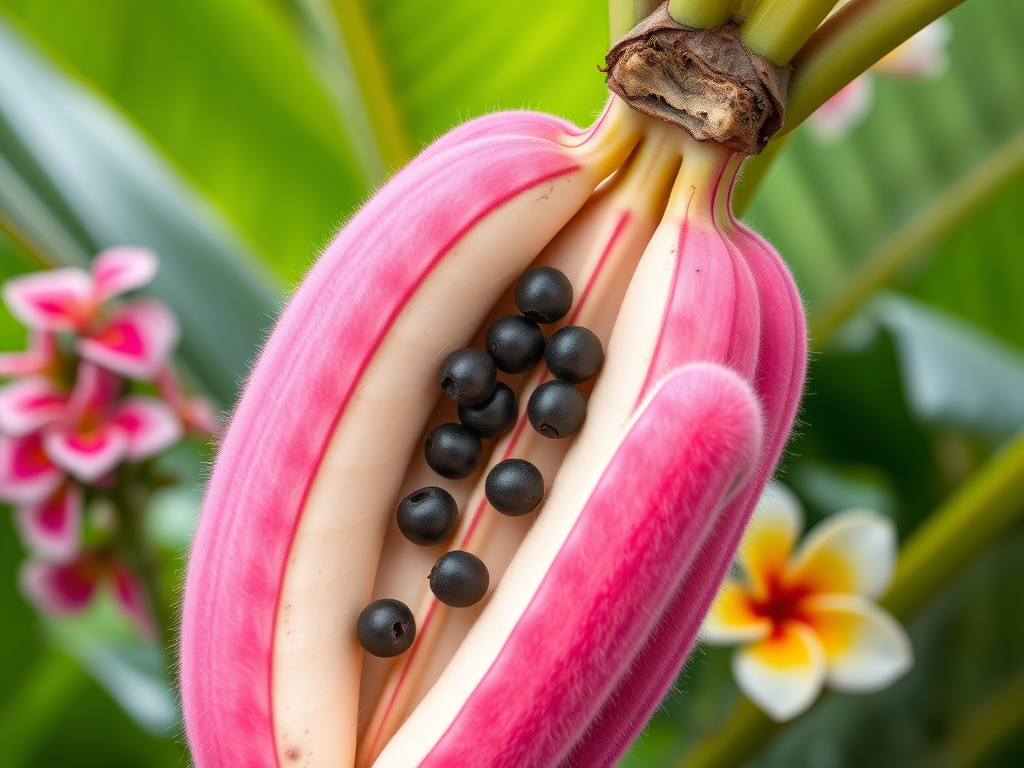
Do you know what a Pink Banana is?
I have the answer, A Pink Banana is nature’s velvet paradox: a tropical perennial known as Musa velutina, native to the eastern Himalayas and Assam. With its fuzzy hot-pink peel and creamy white flesh, it looks like a botanical daydream—but don’t be fooled. Beneath its ornamental charm lies a fruit packed with hard black seeds, making it more admired than devoured.
🌸 Origins & Discovery
Native Region: Eastern Himalayas and Assam
Scientific Classification: First formally described by botanists H. Wendl. & Drude in the late 19th century.
Name Meaning: Velutina is Latin for “velvety,” referencing the fruit’s fuzzy pink skin.
While indigenous communities likely recognized and ritualized this plant long before Western classification, its formal botanical entry came through colonial-era plant exploration—part of the broader 19th-century wave of tropical cataloging.
🕰️ Timeline of Discovery
Musa velutina—native to the eastern Himalayas and Assam—was first formally described and published in 1875 by botanists H. Wendland and Drude in Gartenflora, a German botanical journal.
As for its first use, that’s more nuanced. Indigenous communities in Assam and the Himalayan foothills likely recognized and ritualized this plant long before Western classification. However, documented uses—especially ornamental and ecological—began appearing in horticultural records in the late 19th century, following its formal botanical recognition.
So while 1875 marks its scientific debut, its cultural and ecological presence predates that, woven into the biodiversity and ceremonial landscapes of its native region.
🌿 Modern Cultivation: Who & When
🔬 1950s–1970s: Botanical Interest Blooms
Cultivation expanded through botanical gardens in Europe and North America, especially those focused on tropical and subtropical species.
The Royal Horticultural Society (UK) recognized its ornamental value, eventually awarding it the Award of Garden Merit for its striking appearance and pollinator appeal.
📚 1995: Scientific Propagation Study
Volume 31, Issue 3 (Jul–Sep 1995) of In Vitro Cellular & Developmental Biology
“Germination of Musa velutina Seeds: Comparison of In vivo and In vitro Systems” Authored by Pancholi, Wetten, and Caligari
This study marked a key moment in propagation science for Musa velutina, demonstrating that in vitro methods using gibberellic acid and darkness could dramatically accelerate germination—achieving 82% success in two weeks versus 78% over nine months in natural conditions.
🌱 2000s–Present: Nursery & Ecological Expansion
- Specialty nurseries in the U.S. (e.g., Plant Delights Nursery, Nurseries Caroliniana) began offering Musa velutina as a cold-hardy ornamental for zones 7b–11.
- Tropical fruit vendors like Miami Fruit occasionally offer the fruit for pre-order, though primarily for ornamental or educational use.
🌍 Contributors to Its Spread:
Royal Botanic Gardens, Kew continues to catalog and support its global distribution and taxonomy.
Markku Häkkinen, a Finnish botanist, played a key role in documenting ornamental bananas, including Musa velutina, in his 2005 notes on the Rhodochlamys section.
🌿 Early Uses & Purpose
Ornamental Beauty: Valued primarily for its striking appearance—used in gardens, temple courtyards, and ceremonial landscapes.
Pollinator Magnet: Its vivid pink bracts and creamy flowers attract butterflies and hummingbirds, enhancing biodiversity.
Symbolic Planting: In some cultures, it’s planted as a symbol of exotic abundance or tropical transition, though not widely used for food due to its hard seeds.
Scientific Curiosity: Studied for seed germination and propagation methods—especially in botanical gardens and horticultural research.
This “hairy banana” blooms in late summer, unfurling paddle-shaped leaves and pink bracts that cradle its fruit like ceremonial offerings. Though edible, its texture and seed density make it better suited for storytelling than snacking. Still, it’s a favorite among garden curators and ritual growers who seek tropical flair with a touch of mystery.
🌿 Medicinal Use: Myth or Mystery?
Despite its lush appearance and sweet aroma, Musa velutina has not been cited in peer-reviewed studies or ethnobotanical records as having therapeutic effects. Its fruit is edible but not medicinally potent—largely due to its high seed content and limited flesh.
Ornamental & Biodiversity Value: Its primary “healing” role is ecological: attracting pollinators like butterflies and hummingbirds, which indirectly support garden health and biodiversity. In ceremonial gardens, it may be planted for symbolic vitality or tropical abundance.
Scientific Interest: Research has focused on germination techniques and seed viability, such as the 1995 study comparing in vivo and in vitro propagation methods (Pancholi et al.). These studies are botanical, not medicinal.
🌿 Health Benefits of Musa velutina (Pink Banana)
For Women:
- Contains vitamin C, potassium, and dietary fiber
- Supports heart health, digestion, and energy levels
For Men:
- High potassium may help regulate blood pressure and support muscle function
- Antioxidants may reduce oxidative stress and promote overall vitality
For Hair & Skin:
- Banana pulp masks (seed-free) hydrate and condition dry hair
- Used as a natural moisturizer, improving skin elasticity and soothing irritation
- Offers gentle exfoliation and may reduce acne-related inflammation
For Weight Management:
- Though not practical in large quantities due to seeds, its low-calorie, high-fiber profile echoes the satiety benefits of other bananas
For Tea Rituals:
- Peel tea is rich in antioxidants and may promote relaxation and sleep, similar to other Musa species
Traditional & Cultural Uses:
- In some regions, parts of the plant are used medicinally, though less commonly than other bananas
- Leaves are used for steaming food, and in Central America, they replace corn husks in tamales
🌿 Emerging Health Benefits of Musa velutina
Recent phytochemical reviews and nutritional assessments have begun to explore Musa velutina’s potential, especially in the context of:
Antioxidant Activity: Like other Musa species, M. velutina contains polyphenols and flavonoids that may offer antioxidant effects—helping neutralize free radicals and support cellular health.
Nutritional Value: Though the fruit is small and seed-dense, its creamy pulp contains trace amounts of potassium, vitamin C, and dietary fiber—similar to its more edible cousins. These nutrients support heart health, digestion, and immune function.
Ethnobotanical Interest: While not widely used in traditional medicine, some regional practices may include M. velutina in symbolic plantings or minor topical applications. However, these uses are anecdotal and not well-documented in peer-reviewed studies.
Phytochemical Research: A 2023 review noted that only 18% of Musa species have been studied for medicinal properties, suggesting M. velutina remains underexplored but not without potential.
🍌 Nutritional Echoes
While not a dietary staple, Musa velutina shares key traits with its edible cousins:
- Potassium & Vitamin C: Present in trace amounts, supporting heart and immune health.
- Antioxidants: Contains flavonoids and polyphenols that may help neutralize free radicals.
- Dietary Fiber: Offers digestive support, though limited by seed density.
🧪 Underexplored Medicinal Value
Though not widely used in traditional medicine, emerging phytochemical reviews suggest:
- Antioxidant Activity: Potential cellular protection, similar to other Musa species.
- Ethnobotanical Interest: Symbolic plantings and minor topical uses in regional practices.
- Scientific Curiosity: Only 18% of Musa species have been studied for medicinal properties—M. velutina remains underexplored but not without promise.
🌸 Legacy & Ecological Beauty
Its vivid bracts attract pollinators, enhancing biodiversity in ceremonial gardens. Awarded the Royal Horticultural Society’s Garden Merit, it thrives as a legacy plant—more healing in presence than in pulp.
🍌 Nutritional Comparison: Musa velutina vs. Common Bananas
| Nutrient/Benefit | Musa velutina (Pink Banana) | Common Bananas (Musa acuminata, etc.) |
|---|---|---|
| Edibility | Sweet pulp, but packed with hard seeds—limited use | Fully edible, seedless, widely consumed |
| Potassium | Present, supports heart and muscle health | High levels, known for blood pressure regulation |
| Vitamin C | Trace amounts, supports immunity | Moderate levels, boosts immune function |
| Dietary Fiber | Present, aids digestion | Rich source, supports gut health |
| Antioxidants | Contains flavonoids and polyphenols | Strong antioxidant profile, especially in ripe fruit |
| Vitamin B6 | Not well-documented | Abundant, supports metabolism and brain health |
| Culinary Use | Mostly ornamental; pulp used in jams if seeds removed | Eaten raw, cooked, or blended in various dishes |
| Medicinal Use | Limited and anecdotal | Widely used in traditional medicine and nutrition |
🌿 Editorial Insight
While Musa velutina shares some nutritional traits with its more edible cousins, its dense seed structure and limited pulp make it more of a symbolic fruit than a dietary staple. Still, its potassium, fiber, and antioxidant content offer potential health benefits, especially when used in small quantities or topical applications like skin and hair masks.
🍮 Culinary Uses of the Pink Banana (Musa velutina)
The creamy white flesh, once separated from the hard seeds, can be cooked down into tropical jams or chutneys. Its subtle sweetness pairs well with citrus zest or warming spices like cardamom.
Dessert Garnishes
Small amounts of pulp can be used as a decorative topping for fruit bowls, parfaits, or ceremonial desserts—especially in garden-to-table presentations.
The large, paddle-shaped leaves are traditionally used to wrap food for steaming, much like other banana species. In Central America, they’ve even replaced corn husks for tamales.
While not widely documented for Musa velutina specifically, its peels—like those of other Musa species—can be steeped into a calming tea. Rich in antioxidants, magnesium, and tryptophan, banana peel tea is known to support relaxation, sleep, and digestive ease.
- Banana pulp (seed-free) is used in hair and skin masks, offering hydration and gentle exfoliation.
- These rituals blur the line between culinary and self-care.

Common Names: Hairy Banana, Pink Banana, Pink Fruiting Banana, Pink Velvet Banana
The Pink Banana (Musa velutina) is a tropical perennial from the Musaceae family, celebrated more for its ornamental beauty than its culinary practicality. Thriving in subtropical climates, it typically reaches 4 to 6 feet in height and spreads 3 to 4 feet wide, making it a striking specimen in garden landscapes.
Its lush, paddle-shaped leaves stretch up to 3 feet long, deep green and dramatic. In late summer, the plant unveils creamy tubular flowers embraced by vivid pink bracts—an elegant prelude to its signature fruit. Soon after, clusters of fuzzy, hot-pink bananas emerge, each about 3 inches long.
Though the fruit is sweet and technically edible, it’s densely packed with hard black seeds. As they ripen, the bananas split open naturally, revealing their creamy white flesh. Due to the seed density, they’re rarely consumed and are best appreciated as a botanical curiosity rather than a kitchen staple.
⚠️ Editorial Disclaimer
Due to its seed density, Musa velutina is best suited for ornamental plating, small-batch recipes, or symbolic culinary rituals. Always remove seeds thoroughly and test in moderation.
🍌 Is It Worth Trying?
Yes—if you’re seeking botanical curiosity.
- The fruit is sweet, creamy, and visually stunning.
- It offers nutritional echoes of common bananas: potassium, vitamin C, antioxidants, and fiber.
- Its pulp can be used in small-batch jams, dessert garnishes, or topical rituals for hair and skin.
No—if you’re expecting culinary ease.
- Each fruit is densely packed with hard black seeds, making it labor-intensive to prepare.
- The yield is modest, and the effort often outweighs the edible reward.
- It’s best appreciated as an ornamental legacy plant or a symbolic fruit in garden-to-table storytelling.
🌿 Editorial Verdict: Botanical Potential
The Pink Banana is worth trying once, not for its practicality, but for its ceremonial intrigue, nutritional whispers, and editorial resonance. It’s a fruit that invites reverence, not routine.
🌿 Availability in the U.S.
1. Ornamental Plant Nurseries
- Plant Delights Nursery (NC): Offers Musa velutina as a hardy ornamental for zones 7b–10b.
- Nurseries Caroliniana (SC): Sells it as a cold-hardy, pink-fruiting banana—great for garden aesthetics and biodiversity.
2. Tropical Fruit Vendors
- Miami Fruit (FL): Occasionally offers Pink Seeded Banana for pre-order.
- Sold as unripe racemes (fruit clusters)
- Not guaranteed for consumption—primarily ornamental
- Limited seasonal availability
🛒 Editorial Note
While the fruit is technically edible, vendors often emphasize its ornamental value and seed density, advising against expecting a snack-worthy experience. It’s best acquired for garden-to-table storytelling, pollinator attraction, or ceremonial planting.
🌿 Botanical Potential: Musa velutina (Pink Banana)
The Pink Banana is more than ornamental—it’s a botanical whisper of healing. From antioxidant-rich peels to nutrient-laced pulp, Musa velutina offers quiet potential in tea rituals, topical masks, and small-batch preserves. Its leaves wrap food with cultural grace, and its vivid bracts attract pollinators, enriching ecological balance.
Though its fruit is densely seeded and rarely consumed whole, its ceremonial uses—hydrating skin, soothing digestion, calming the nervous system—invite reverence. It’s a healing herb not for volume, but for intention.
Now you know. The rest is up to you. Will you steep it, plant it, or simply honor its presence?
 EJADA
EJADA 
Leave a comment