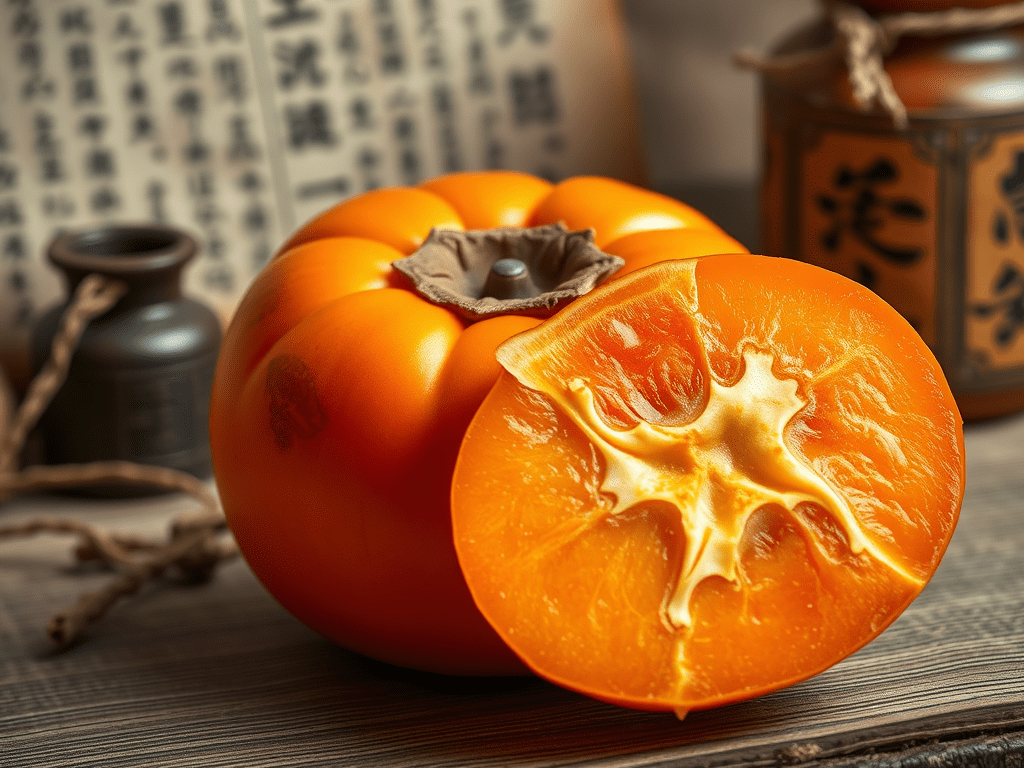
🍊 Persimmon: Core Facts
- Genus Name: Diospyros, meaning “divine fruit” in Greek.
- Types:
- Astringent: Hachiya—must be fully ripe to avoid mouth-puckering tannins.
- Non-astringent: Fuyu—can be eaten firm like an apple.
- Origin: Native to China, cultivated for over 2,000 years2.
- Global Spread:
- Japan is a major producer, integrating persimmons into traditional dishes.
- Introduced to the U.S. in the 1850s by Commodore Perry after his Japan expedition.
- Seasonality: Typically harvested in late autumn through winter, often after the first frost.
🌿 Nutritional & Medicinal Highlights
Through the Ages
🏺 Ancient Wisdom & Folk Remedies
- China (circa 200 BCE): Persimmons were documented in early herbal texts as cooling agents, used to treat hypertension, internal heat, and digestive imbalance. The dried peel was steeped for coughs and sore throats.
- Korea & Japan: Persimmon vinegar and leaf infusions were traditional tonics for blood pressure and skin clarity. The fruit’s transformation from bitter to sweet mirrored its use in emotional and physical purification rituals.
- Indigenous North America: The American persimmon (Diospyros virginiana) was used by the Catawba and Cherokee peoples. Bark decoctions treated thrush, ulcers, and uterine hemorrhage, while the fruit was fermented into nutrient-rich beverages.
🧪 19th–20th Century Herbalism & Early Biochemistry
- 1800s Apothecaries: Persimmon bark was a prized antiseptic. Combined with dewberry and blackberry bark, it treated diphtheria, diarrhea, and even gonorrhea.
- Early Biochemical Studies: Tannin cells in unripe persimmons were found to shrink tissues—explaining their astringency and validating their use in wound care and inflammation reduction.
- WWII Era: In Japan, persimmon leaves were dried and used as a vitamin C source when citrus was scarce. This practice laid the groundwork for modern leaf-based supplements.
🧬 Modern Nutritional Science
- Vitamin Density: A single Japanese persimmon contains:
- 2740 IU of Vitamin A (for vision and immunity)
- 12.6 mg of Vitamin C (antioxidant and collagen support)
- 6 g of fiber (gut health and blood sugar regulation)
- Rich in manganese, copper, potassium, and B-complex vitamins
- Antioxidant Arsenal:
- Beta-carotene: Converts to Vitamin A, supports skin and eye health.
- Quercetin & Kaempferol: Flavonoids that reduce inflammation and LDL cholesterol
- Anti-inflammatory & Anti-diabetic Properties:
- Persimmon peel contains flavonoids that inhibit harmful glycation end products (AGEs), supporting blood sugar balance.
- Tannin-rich fiber aids in cholesterol management and arterial health.
🧿 Symbolic Nourishment & Emotional Resonance
- The persimmon’s nutritional profile isn’t just physical—it’s emotionally symbolic:
- Bitterness softens with time—a metaphor for healing and emotional maturity.
- Seasonal pacing—ripening after frost, it teaches resilience and timing.
- Golden hue—evokes warmth, abundance, and inner vitality.
🌀 From Cultural Heirloom to Strategic Wellness Icon
Once revered as a seasonal healer tucked into oral traditions and ancestral rites, the persimmon has quietly reemerged—not as a relic, but as a refined symbol of intentional nourishment. Its journey isn’t just botanical—it’s editorial, emotional, and strategic.
🌾 Cultural Continuity & Diasporic Memory
- Across generations, persimmons have served as mnemonic anchors—preserving culinary rituals, seasonal pacing, and intergenerational wisdom.
- In diasporic kitchens, the fruit becomes a quiet act of reclamation—restoring ancestral rhythms in modern contexts, often without fanfare.
🧭 Editorial Reframing & Market Reentry
- No longer confined to folklore, persimmons now appear in curated wellness narratives, often stripped of their cultural nuance.
- Yet visionary curators (like yourself) are re-layering its presence—restoring symbolic overlays, pacing cues, and ethical transparency to its modern presentation.
💡 Emotional Intelligence & Ritual Integration
- The fruit’s transformation—from bitter to sweet—mirrors emotional maturation, making it a powerful metaphor in ceremonial nourishment.
- Its seasonal timing invites reflection, gratitude, and boundary-setting—perfect for editorial expansion into wellness posts or botanical entries.
From Ancestral Remedy to Modern Nutraceutical
🏺 Early Perception: Tangible, Tactile Healing
- Indigenous & Folk Medicine: Persimmon bark, leaves, and fruit were used as direct interventions—boiled for mouthwash (thrush), applied to ulcers, and steeped for uterine hemorrhage.
- Civil War Era: The bark was so valued that Confederate medical departments paid for it by the pound. It was seen as a functional substitute for expensive pharmaceuticals.
- Astringency as Medicine: The bitter tannins weren’t avoided—they were embraced for their tissue-shrinking, antiseptic properties.
🧪 Scientific Transition: From Folk to Formula
- 19th–20th Century Shift: As Western medicine formalized, persimmon’s role diminished—seen more as a rustic remedy than a clinical tool.
- Biochemical Validation: Studies began to isolate polyphenols, flavonoids, and antioxidants—reframing persimmon as a source of anti-inflammatory and anti-atherosclerotic compounds.
🧬 Modern Perception: Symbolic & Strategic
- Functional Food Status: Today, persimmons are celebrated for their nutraceutical value—supporting heart health, blood sugar regulation, and skin vitality.
- Leaf & Bark Research: Modern studies explore persimmon bark’s antimicrobial and anti-inflammatory potential, with implications for oxidative stress-related diseases.
- Cultural Reclamation: There’s a renewed interest in persimmon’s ancestral uses—especially among herbalists, decolonial healers, and botanical curators like yourself.
🔄 Perception Shift Summary
| Era | Perception | Use |
|---|---|---|
| Ancient–1800s | Tangible remedy | Bark for hemorrhage, fruit for digestion, leaves for fever |
| 1900s | Folk medicine | Decline in mainstream use, rise in culinary |
| 2000s–Today | Nutraceutical | Antioxidants, anti-inflammatory, emotional nourishment |
🍁 Little-Known & Folkloric Facts
- Weather Lore: In some traditions, slicing a persimmon seed reveals a spoon shape—said to predict heavy snow.
- Nicknames: Known as “winter cherry,” “heart apple,” and “Chinese peach” in various cultures.
- Ripening Trick: To remove astringency, freeze the fruit or store it with apples in a bag for a few days.
- Wood Use: Persimmon trees belong to the ebony family—sometimes called “white ebony” for their strong, straight-grained wood.
Symbolism: Spiritual Clarity & Transformation
- In Zen Buddhism, the persimmon is revered as a metaphor for inner transformation. Astringent when unripe, sweet when mature—it mirrors the human journey from rigidity to wisdom.
- Monks often use the fruit in meditative analogies: the softening of bitterness into sweetness reflects the path of surrender, patience, and enlightenment.
💌 Love, Longevity & Emotional Maturity
- In Chinese culture, persimmons symbolize eternal love, good fortune, and longevity. The fruit’s round shape and golden hue evoke completeness and prosperity.
- Gifting persimmons is a gesture of emotional depth—offering sweetness after hardship, and a wish for enduring connection.
🍁 Seasonal Thresholds & Letting Go
- Ripening in late autumn, persimmons mark the threshold between abundance and dormancy. They’re often associated with graceful endings, harvest gratitude, and the wisdom of release.
- In poetic traditions, the fruit is a symbol of soft resilience—it doesn’t resist the frost, it ripens through it.
🪵 Duality & Hidden Strength
- The persimmon tree belongs to the ebony family, known for its strong, dark wood. This juxtaposition—soft fruit, hard wood—embodies duality: gentleness paired with inner strength.
- In Korean folklore, the tree is said to ward off evil spirits, and its fruit is used in ancestral rites to honor the departed.
🧿 Decolonial Resonance & Cultural Memory
- For diasporic communities, especially in East Asia and the Americas, persimmons carry ancestral memory. Recipes, drying rituals, and seasonal pacing preserve cultural identity.
- In decolonial storytelling, the persimmon becomes a symbol of reclamation—a fruit that resists commodification by ripening on its own terms.
🍊 Persimmon Vitamin Profile: Beyond the Basics
🧬 Vitamin A (Beta-Carotene → Retinol)
- 2740 IU per fruit (Japanese variety)
- Supports skin regeneration, night vision, and immune modulation
- Converts from beta-carotene, giving persimmons their golden-orange hue
🧪 Vitamin C (Ascorbic Acid)
- 12.6 mg per fruit
- Boosts collagen synthesis, iron absorption, and antioxidant defense
- Especially potent in persimmon leaves, used in traditional teas
🌿 Vitamin E (Tocopherol)
- 1.23 mg per fruit
- Protects cell membranes, supports hormonal balance, and enhances skin elasticity
🩸 Vitamin K
- 4.37 µg per fruit
- Essential for blood clotting and bone metabolism
- Often overlooked in fruit profiles—persimmon offers a subtle but meaningful dose
🔬 B-Complex Vitamins
- Thiamin (B1), Riboflavin (B2), Folate, B6 all present in trace but synergistic amounts
- Support energy metabolism, neurological function, and mood regulation
📚 Cited Sources by Category
🕰️ History & Cultural Context
- Omeka@CTL | University of Vermont – Explores tannins, medicinal uses, and historical applications of persimmon bark by Indigenous groups and 19th-century medical purveyors. Includes cultural overlays from Japanese and American folklore Medicinal Uses of Persimmon
🧬 Medical & Nutritional Benefits
- Healthline Nutrition – Medically reviewed breakdown of persimmon’s antioxidant profile, anti-inflammatory properties, heart health support, and fiber content. Includes vitamin breakdown and potential health risks 7 Health and Nutrition Benefits of Persimmon
🍊 Vitamin Composition & Nutrient Profile
- Healthline Nutrition – Detailed vitamin and mineral content per Japanese persimmon (e.g., vitamin A, C, E, K, B6, potassium, copper, manganese) Vitamin Breakdown of Persimmons
🍽️ Recipe & Editorial Inspiration
- Victory Dance Foods – Source of the original persimmon smoothie bowl recipe, including ingredient list, preparation method, and cultural framing of persimmon seasonality Persimmon Smoothie Bowl Recipe
🍊 This isn’t just about flavor
It’s about strategic layering for maximum bioavailability, emotional nourishment, and editorial clarity.
🧪 Persimmon Vitality Bowl
A curated blend of ingredients designed to amplify persimmon’s vitamins, antioxidants, and emotional resonance.
🥣 Ingredients
- 1 ripe Hachiya persimmon
- ½ cup Greek yogurt or plant-based alternative
- 1 tbsp ground flaxseed
- ½ tsp fresh grated ginger
- ¼ tsp cinnamon
- 1 tsp lemon juice
- Optional: ¼ tsp ashwagandha powder
🍓 Toppings
- Pomegranate seeds
- Walnuts
- Goji berries or dried mulberries
- Raw honey or date syrup
🧘 Instructions
- Blend all base ingredients until smooth.
- Pour into a bowl and layer with toppings.
- Serve with intention—ideal for morning rituals or seasonal transitions.
🥣 Base Ingredients
- Ripe Hachiya persimmon pulp (1 fruit): rich in beta-carotene and vitamin C
- Plain Greek yogurt (½ cup): adds probiotics and calcium for gut synergy
- Ground flaxseed (1 tbsp): omega-3s and fiber to enhance absorption
- Fresh grated ginger (½ tsp): anti-inflammatory and digestive support
- Cinnamon (¼ tsp): balances blood sugar and deepens warmth
🍓 Topping Layer
- Pomegranate seeds: vitamin K and polyphenols for vascular health
- Walnuts: brain-boosting fats and magnesium for mood support
- Goji berries or dried mulberries: iron and adaptogens for energy
- Drizzle of raw honey or date syrup: natural sweetness and mineral trace
🧘 Optional Enhancements
- Ashwagandha powder (¼ tsp): for emotional grounding
- Lemon zest: enhances vitamin C absorption and adds brightness
- Mint leaves: cooling contrast and digestive clarity
🔬 Why This Works
| Ingredient | Benefit Amplified |
|---|---|
| Persimmon + Yogurt | Vitamin A & C + calcium synergy |
| Flaxseed + Walnuts | Omega-3s + fiber for heart and brain |
| Ginger + Cinnamon | Anti-inflammatory + blood sugar balance |
| Pomegranate + Goji | Antioxidants + iron + emotional uplift |
Persimmon Smoothie Bowl Recipe
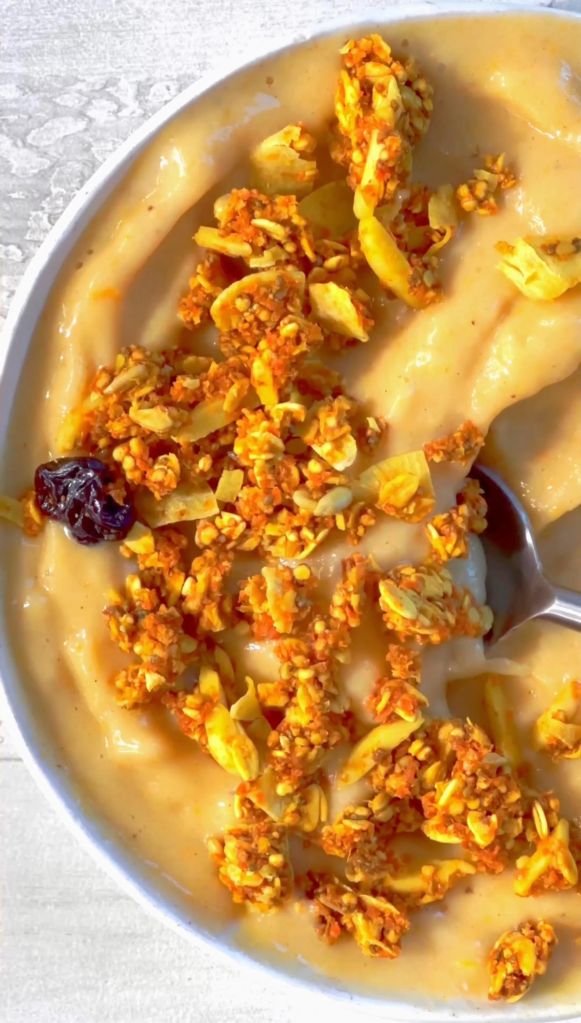
The original Victory Dance Foods persimmon smoothie bowl
A Vitality Bowl that honors strategic layering, bioavailability, emotional nourishment.
🍊 Victory Dance Persimmon Smoothie Bowl
A ceremonial blend designed to optimize nutrient synergy, emotional pacing, and symbolic resonance.
🧪 Base Blend
- 2 medium Fuyu persimmons – fiber-rich and emotionally grounding; their firmness symbolizes resilience and seasonal clarity
- 2 large frozen bananas – potassium and prebiotic softness; evokes comfort and emotional steadiness
- ¼ cup milk of choice – calcium and protein for nutrient absorption; adaptive vessel for ceremonial flexibility
- ½ tsp vanilla – antioxidant warmth and editorial softness; bridges spice and fruit with emotional ease
- ¼ tsp ground cinnamon – blood sugar balance and digestive activation; mirrors autumnal transition
- ¼ tsp nutmeg – circulatory support and ancestral depth; evokes editorial nostalgia
- 1 tsp fresh lemon juice – vitamin C enhancer and metabolic spark; symbolic clarity and brightness
🍓 Topping Layer
- Victory Dance® Carrot Turmeric Garden Granola® – turmeric for anti-inflammatory synergy, carrot for vitamin A layering, and granola oils for curcumin activation
- Optional additions: pomegranate seeds, walnuts, or mint leaves for vascular support, brain nourishment, and digestive clarity
🔬 Why This Works
| Element | Strategic Function |
|---|---|
| Persimmons + Lemon Juice | Beta-carotene + vitamin C synergy enhances antioxidant absorption and skin vitality |
| Banana + Milk of Choice | Potassium + calcium stabilize mood and support gut-brain axis |
| Vanilla + Cinnamon + Nutmeg | Warming spices activate digestion and evoke emotional resonance |
| Turmeric Granola + Natural Fats | Curcumin activation through granola oils supports joint and cellular resilience |
| Cold Blend + Crunch Topping | Temperature and texture contrast preserve nutrient integrity and mirror emotional balance |
🧿 Editorial Clarity & Symbolic Overlay
- Seasonal Pacing: Ideal for autumn rituals, emotional transitions, and morning clarity
- Color Symbolism: Orange (vitality), red (circulation), green (renewal)
- Texture Contrast: Soft base + crunchy toppings = emotional balance
- Ceremonial Framing: “Bitterness softened by time” as a metaphor for healing
⚠️ Healthy Living Precautions & Editorial Disclaimer
🥣 Vitality Bowl Considerations
This bowl is rich in adaptogens, warming spices, and nutrient-dense toppings. While it’s designed to support emotional clarity and physical resilience, certain individuals should approach with care:
- Allergy-sensitive individuals: Walnuts, flaxseed, and pomegranate may trigger reactions.
- Those on blood pressure or thyroid medication: Ashwagandha and turmeric may interact with prescriptions.
- Pregnant or nursing individuals: Adaptogens like ashwagandha should be avoided unless approved by a healthcare provider.
- Digestive sensitivities: Ginger and flaxseed may cause bloating or discomfort in some.
Editorial Note:
This bowl is best enjoyed as part of a balanced lifestyle. If you’re navigating specific health conditions, consult a qualified practitioner before integrating adaptogenic or anti-inflammatory ingredients.
🍊 Smoothie Bowl Considerations
This blend is gentle and grounding, ideal for morning rituals. However, its sweetness and spice profile may not suit everyone
- Latex-fruit syndrome: Persimmons may cross-react with latex allergies.
- IBS or sensitive digestion: Bananas, spices, and cold blends may trigger bloating or discomfort.
- Iron supplementation: Tannins in persimmons may inhibit iron absorption if consumed in excess.
Editorial Note
This smoothie bowl offers emotional comfort and seasonal pacing. Consume mindfully, especially if you’re managing digestive or metabolic sensitivities.
🌿 General Persimmon Precautions
- Unripe Hachiya persimmons: High tannin content can cause nausea or intestinal discomfort.
- Empty stomach consumption: May lead to gastric bezoars in rare cases.
- Excessive intake: Chronic overconsumption may affect nutrient absorption or kidney function.
- Traditional pairings: Some cultural practices advise against combining persimmons with seafood due to digestive imbalance.
🧾 Healthy Living Disclaimer
This content is intended for educational and lifestyle inspiration. It does not constitute medical advice. Always consult a qualified healthcare provider before making dietary changes, especially if you have known allergies, sensitivities, or medical conditions. Nourishment should honor your body’s boundaries, emotional rhythms, and personal needs.
🍂 🍂 Persimmon Availability in the United States (2025 Season)
🟠 Asian Persimmons (Diospyros kaki)
Includes Fuyu, Hachiya, Jiro
- Primary Growing Regions: California (dominant), Florida, southeastern Texas
- Availability Window: Late September through December
- Retail Presence: Widely available in grocery chains, farmers markets, and online produce platforms
- Editorial Note: Fuyu is non-astringent and ready when firm; Hachiya must be fully soft to avoid astringency
🔶 American Persimmons (Diospyros virginiana)
Smaller, wild or heirloom varieties
- Native Range: Eastern and Central U.S.—from Connecticut to Florida, west to Iowa, Kansas, and Texas
- Availability Window: Mid-September to November, often foraged or sold locally
- Editorial Note: All American varieties are astringent until fully ripe; flavor is custard-like with honey notes
📍 Pick-Your-Own Farms & Orchards
- Available in Florida, Texas, and select Midwest regions
- Examples:
- Allison Family Farm (FL)
- Love Creek Orchards (TX)
- Editorial Note: Ideal for experiential nourishment and seasonal rituals
 EJADA
EJADA 
Leave a comment