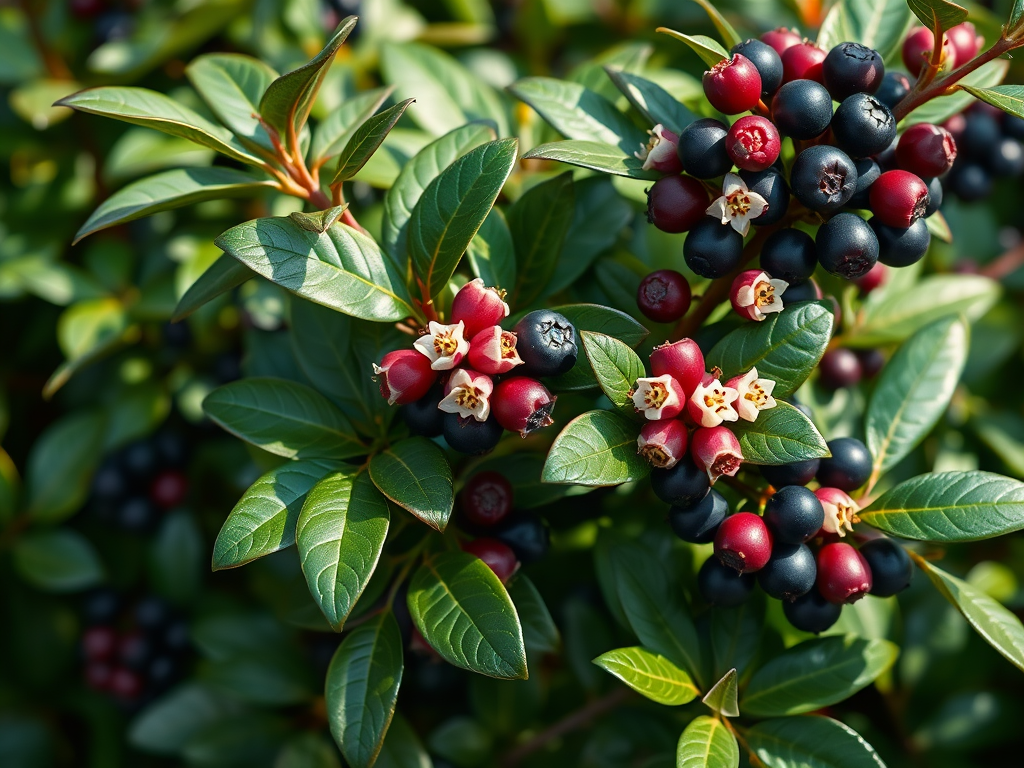
The very first medicinal uses of evergreen huckleberry trace back centuries to the Indigenous peoples of the Pacific Northwest Coast—tribes like the Coast Salish, Comox and Quinault—who brewed teas from the leaves and used the berries and poultices to ease digestive upsets, urinary complaints and to help regulate blood-sugar levels. These practices were recorded in early ethnobotanical surveys and today modern herbalists still acknowledge the plant’s healing potential
Evergreen huckleberry (Vaccinium ovatum) is a hardy, shade-loving shrub native to the Pacific Northwest and coastal regions of North America. It’s part of the same plant family as blueberries and cranberries, and it’s known for its glossy, dark green leaves that stay vibrant year-round.
In spring, it produces delicate pinkish-white bell-shaped flowers that attract pollinators like hummingbirds and butterflies. By late summer, those blooms give way to small, edible berries that range from deep purple to blue-black. The berries are sweet—especially after a frost—and have been enjoyed by Indigenous peoples for generations, both fresh and dried.
It’s also a favorite in landscaping thanks to its versatility: it can grow in sun or shade, reaches 3–12 feet depending on conditions, and its foliage is often used in floral arrangements. If you’re into native gardening or just want a low-maintenance, wildlife-friendly plant, evergreen huckleberry is a real gem.“huckleberries” aren’t just a Pacific Northwest curiosity; several species grow wild and are sold commercially across the U.S.:
Western U.S. (Pacific Northwest) – Vaccinium ovatum, the evergreen huckleberry, is native from California through Oregon and Washington, thriving in acidic, well-drained soils under partial shade. You’ll find plants at native-plant nurseries (e.g., Portland Nursery carries V. ovatum for USDA zones 7–9) and fruit in farmers’ markets or specialty grocers late summer into fall.
Eastern U.S. (Appalachians & Beyond) – Black huckleberry (Gaylussacia baccata) ranges from the southern states up into Canada. – The rarer box huckleberry (G. brachycera) pops up in the central Appalachians, though it isn’t commercially cultivated due to its poor flavor and large seeds.
Commercial & Wild Harvest – In western national forests (e.g., parts of Washington and Idaho), you can forage V. membranaceum (“black huckleberry”) and V. parvifolium (“red huckleberry”) under personal-use guidelines. – Many farms and U-pick operations in Montana, Idaho, and Oregon offer seasonal huckleberry picking, and you’ll also see frozen or jam-packed huckleberries sold online or in health-food stores.
Evergreen huckleberry has a long history of medicinal use, especially among Indigenous peoples of the Pacific Northwest. Tribes such as the Sechelt, Comox, and Quinault used both the berries and leaves not just for food, but for healing purposes as well.
The leaves were traditionally brewed into teas to help regulate blood sugar levels—an early form of diabetes management. They were also used for their astringent and antiseptic properties, believed to aid urinary tract health and stimulate appetite. While exact dates are hard to pin down, these practices go back centuries, passed down through oral tradition and lived experience.
Evergreen huckleberries are a nutritional powerhouse whose tiny berries deliver big health perks:
Rich in Antioxidants The deep purple hue of these berries comes from anthocyanins and other polyphenols, compounds shown to neutralize free radicals, reduce oxidative stress, and lower your risk of chronic ailments like heart disease and certain cancers.
Vitamin & Mineral Boost Just a handful provides generous doses of vitamin C (supporting immunity and collagen production), vitamin K (essential for bone health and proper blood clotting), manganese (a cofactor in metabolism and bone formation), plus trace minerals like potassium that help regulate blood pressure.
Fiber for Digestive & Metabolic Health With their high dietary fiber content, huckleberries promote healthy gut motility, stabilize blood sugar swings, and can aid weight management by increasing satiety without piling on calories.
Heart-Protective Benefits Regular intake has been linked to improved cardiovascular markers: lowering blood pressure, reducing arterial stiffness, inhibiting unwanted clot formation, and helping to manage cholesterol levels—thanks largely to their anti-inflammatory and antioxidant actions.
Eye Health Support Beyond general antioxidants, huckleberries carry vitamins A, B, C, and carotenoids like lutein, which accumulate in the retina, shielding your eyes from age-related degeneration and helping maintain sharp vision.
Skin Defense & Rejuvenation The same antioxidant firepower defends skin cells against UV damage and environmental pollutants, which can translate into fewer wrinkles, better elasticity, and a more even, radiant complexion over time.
Beyond these core benefits, you can enjoy evergreen huckleberries fresh, frozen, or dried. They’re a brilliant addition to smoothies, jams, salads, or even green-tea infusions.
Rich in antioxidants: These berries are loaded with anthocyanins and polyphenols, which help combat oxidative stress and may reduce the risk of chronic diseases like heart disease and cancer.
And the best part? They’re low in calories but high in flavor, making them a guilt-free addition to smoothies, baked goods, or even just snacking straight from the bush.
Here’s a step-by-step approach to foraging evergreen huckleberries safely and sustainably:
Proper Identification Look for Vaccinium Ovatum glossy, evergreen oval leaves (1–3 cm long) and dangling clusters of deep purple–black berries roughly 5–10 mm in diameter. Blooms in spring with bell-shaped, pinkish-white flowers; fruits ripen midsummer to early fall in coastal or forest-understory habitats. Use a local wild-edibles field guide or app to cross-check against look-alikes like salal or bearberry.
Scout Legal, Clean Sites Get landowner permission or check state/local regulations—many parks restrict foraging. Avoid roadsides and industrial areas to reduce pesticide and heavy-metal exposure. Stick to well-drained, acidic soils under partial shade, where huckleberries thrive.
Harvest Gently and Sustainably Hand-pick ripe berries individually; don’t strip whole clusters at once. Only take up to one-third of the fruit on each bush to feed wildlife and ensure next season’s crop. Tread lightly—step on established trails to avoid trampling young shoots or other understory plants.
Use the Right Tools • A soft, cloth-lined basket or a homemade bucket with side slits keeps berries from squashing and lets debris sift out. If you try a huckleberry rake, use it sparingly and at the right angle to avoid tearing branches or uprooting the plant.
Post-Harvest Care • Rinse gently in cool water, removing twigs and leaves—avoid soaking to preserve flavor. Dry on a single layer of clean towels and refrigerate up to a week or freeze in a single layer before bagging for long-term storage.
Ready to turn your haul into jam, tea, or a vibrant smoothie?
Here are four simple ways to fold fresh or frozen huckleberries into your day—each one low-cal, high-impact, and brimming with flavor:
Morning Huckle-Spinach Smoothie Ingredients • ½ cup fresh or frozen huckleberries • 1 cup baby spinach • 1 small banana (for creaminess and natural sweetness) • ½ cup plain Greek yogurt (or dairy-free alternative) • ¾ cup almond milk (or oat milk) • 1 tsp chia seeds (optional fiber boost) Steps • Toss everything into your blender in order (liquid first) so blades spin freely. • Blend on high for 30–45 seconds until velvety smooth. • Taste—if it’s too tart, add a date or a drizzle of honey.
Summer Huckleberry & Feta Salad Ingredients • 3 cups mixed greens (arugula, baby kale, or spring mix) • ½ cup fresh huckleberries • 2 oz crumbled feta or goat cheese • ¼ cup thinly sliced red onion • 2 tbsp toasted pecans or walnuts • Simple vinaigrette (2 tbsp olive oil, 1 tbsp apple-cider vinegar, 1 tsp Dijon, pinch salt+pepper) Steps • Whirl the vinaigrette ingredients in a jar. • In a bowl, layer greens, berries, onion, nuts, and cheese. • Drizzle dressing, toss lightly, and serve immediately.
One-Pot Huckleberry Jam Ingredients • 2 cups huckleberries, rinsed • ½ cup sugar (or coconut sugar) • Zest and juice of 1 lemon • 1 tsp chia seeds (natural thickener) Steps • In a small saucepan over medium heat, combine berries, sugar, and lemon. • Gently mash with a fork, then simmer 10–12 minutes, stirring occasionally. • Off the heat, stir in chia seeds. Let cool—jam will thicken as it chills. • Spoon into a sterilized jar; refrigerate up to 2 weeks or freeze in ice-cube trays.
Iced Huckleberry-Green Tea Refresher Ingredients • 2 green-tea bags • 2 cups water (just off boil) • ½ cup huckleberries, lightly crushed • 1–2 tsp honey or agave (to taste) • Ice cubes and sprigs of mint Steps • Steep tea bags in hot water for 3–4 minutes, then discard bags. • Stir in honey until dissolved; let cool to room temp. • In a pitcher, muddle berries lightly with the back of a spoon. • Pour over tea, add ice and mint—and chill 30 minutes for full flavor meld.
Beyond sipping and snacking, you can swirl huckleberry purée into yogurt bowls, fold them into pancake batter, blend into vinaigrettes, or even steep the leaves for a mild, antioxidant-rich tea. Let me know if you’d like more detailed proportions, preservation tips, or even a DIY face-mask recipe using huckleberry extracts!
The huckleberry plant, Solanum nigrum L., belongs to the Solananceae family of
plants and was first domesticated in Europe and West Asia before being introduced to America, Australia, Malaysia, and Indonesia. This article will discuss some amazing health benefits of huckleberry. Keep reading: 24 Proven Health Benefits
Huckleberries and blueberries resemble each other because they’re close botanical cousins:
Same Family & Genus Both belong to the heath family (Ericaceae) and the Vaccinium genus, so they inherited similar shrub habit, leaf shape and berry structure.
Shared Pigments They produce the same anthocyanin pigments in their skins, which give both fruits that deep blue-purple color.
Parallel Ecology Each thrives in acidic, well-drained soils as low, woody understory shrubs. Over millennia, similar environmental pressures shaped their round berries of roughly the same size.
Common Heritage of Names Early English settlers even used the words “hurtleberry” or “whortleberry”—ancient names for blueberries—when they first encountered true huckleberries, cementing the visual link in our language.
But be careful if you fall into any of these
Here are the main groups who should steer clear of—or at least use extreme caution with—evergreen huckleberry leaves and berries:
• People on blood-sugar lowering medication The leaves (and to a lesser extent the berries) have been shown to reduce blood glucose levels. If you’re taking insulin or other diabetes drugs, adding huckleberry leaf tea could tip you into hypoglycemia unless you closely monitor and adjust your dosages with your doctor’s guidance.
• Those with berry or Salicylate allergies Though true toxicity is essentially nil, evergreen huckleberry belongs to the Vaccinium family. Anyone with known strawberry, blueberry or aspirin/Salicylate hypersensitivities should avoid it—reactions can include itching, rashes or gastric upset.
• Pregnant or nursing women No clinical safety data exists for huckleberry in pregnancy or lactation. Until more research emerges, it’s best to err on the side of caution and skip the leaf teas and large-dose berry preparations.
• Young children and sensitive stomachs While generally regarded as kid-safe, overindulgence can provoke mild stomach cramps or diarrhea. If you’re introducing huckleberries to little ones for the first time, start with just a few and watch for any upset.
If you fall into one of these categories but still want the antioxidant boost, consider talking to your healthcare provider about appropriate dosing, or look for a standardized extract with clearer safety data.
 EJADA
EJADA 
Leave a comment