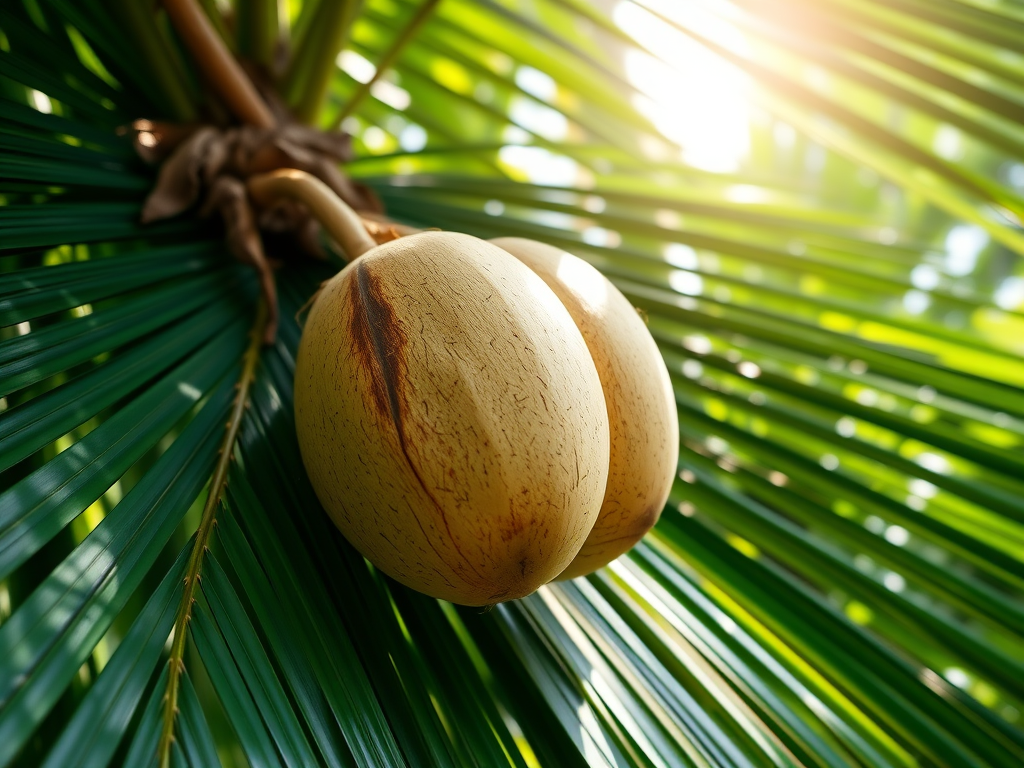
The Double Coconut name comes from the fruit’s unique shape: the seed has two lobes that resemble a pair of buttocks, which earned it the cheeky nickname coco fessesBritannica in French. The tree itself can grow up to 30 meters tall and has enormous fan-shaped leaves that can span 10 meters across.
(The contents of the nut are edible but are not commercially valuable. Water vessels and platters are made from the shells. The empty fruits (after germination of the seed) are found floating in the Indian Ocean and were known long before the palm was discovered. Britannica.com)
The double coconut (Lodoicea maldivica) was first documented in 1563 under the name Coco das Maldivas—“coconut of the Maldives”—by the Portuguese physician Garcia de Orta. At the time, no one knew where the massive seeds originated, as they were often found floating in the Indian Ocean, leading to myths that they grew on underwater trees.
It wasn’t until 1768 that the mystery was solved. French explorer Marc-Joseph Marion du Fresne landed in the Seychelles and discovered that the seeds actually came from a terrestrial palm tree growing on the islands. This revelation transformed the double coconut from a nautical enigma into a botanical marvel.
The double coconut, also known as Lodoicea maldivica or coco de mer, is a rare palm tree native only to the Seychelles islands—specifically Praslin and Curieuse. It’s famous for producing the largest and heaviest seed in the plant kingdom, with some seeds weighing up to 25 kg (55 lbs) and measuring nearly half a meter long.
The double coconut is dioecious, meaning male and female flowers grow on separate trees. It takes 6–7 years for the fruit to mature and another 2 years to germinate, making it one of the slowest-growing plants on Earth.
Due to its rarity and slow reproductive rate, it’s listed as endangered and protected under international conservation laws.
It’s not just a botanical marvel—it’s also steeped in myth and mystery. For centuries, people believed the nuts came from underwater trees because they were sometimes found floating in the Indian Ocean long before the actual trees were discovered.
The double coconut—or coco de mer—earned its reputation as the “forbidden fruit” largely because of its provocative shape and the mystery that surrounded its origin for centuries. The seed resembles a woman’s pelvis and buttocks on one side, and a belly and thighs on the other, which sparked associations with sensuality, fertility, and temptation.
In the 19th century, General Charles George Gordon visited the Seychelles and became convinced that the lush Vallée de Mai forest, where the coco de mer grows, was the original Garden of Eden. He proposed that the double coconut was the very fruit that tempted Eve. Its erotic form, combined with the fact that it only grows in a secluded paradise, made it a perfect candidate for this biblical role.
Local legends added fuel to the fire. One tale claimed that male and female trees mated on stormy nights, and that witnessing this act would cause death or blindness. Since pollination of the coco de mer is still not fully understood, the myth persisted with a kind of mystical allure.
Cultural Significance
The double coconut (Lodoicea maldivica) has long been considered a status symbol and object of desire. In centuries past, these seeds were so prized that owning one was a sign of nobility. Royals and emperors in Europe and Asia collected them as curiosities, so that some were mounted in gold and used as ceremonial gifts. In fact, during the 18th century, possession of a coco de mer without royal permission in the Seychelles could get you executed—that’s how valuable and rare they were.
Today, the nut is a protected item under CITES, meaning it can’t be exported without a special license. Locally, artisans carve the shells into decorative objects, bowls, and souvenirs, but even these are tightly regulated.
Compared to Regular Coconuts
Here’s how it stacks up:
| Feature | Double Coconut (Lodoicea) | Regular Coconut (Cocos nucifera) |
|---|---|---|
| Origin | Seychelles only | Tropical regions worldwide |
| Seed Size | Up to 55 lbs (25 kg) | About 3–5 lbs (1.5–2.5 kg) |
| Time to Mature | 6–7 years | About 1 year |
| Tree Height | Up to 30 m | 20–30 m |
| Uses | Ornamental, symbolic, mythical | Edible, culinary, industrial |
| Cultural Status | Mythic, royal, erotic symbolism | Everyday staple and global commodity |
So while a regular coconut is your go-to for smoothies, oil, or curry, the double coconut is more like a natural sculpture cloaked in mystery and lore.
The double coconut (Lodoicea maldivica) isn’t widely consumed due to its rarity and protected status, but traditional medicine systems like Ayurveda, Siddha, and Chinese medicine have long attributed therapeutic properties to it.
Fever relief: The kernel is considered a febrifuge, meaning it may help reduce fever.
Diabetes support: A decoction made from the husk and kernel has been used to lower sugar levels in urine.
Digestive aid: It’s been used to treat colic, diarrhea, and hyperdipsia (excessive thirst).
Detoxifying effects: Traditional texts mention its use as an antidote for opium and aconite poisoning.
Anti-inflammatory and soothing: In Chinese medicine, it’s used to ease abdominal discomfort and inflammation.
That said, these uses are based on traditional knowledge and anecdotal evidence; there’s limited modern scientific research to confirm them. Because the plant is endangered, its medicinal use is now more symbolic than practical.
Double coconut product is available in the U.S., though not the whole fruit in its raw form, due to strict conservation laws. Here’s what’s available:
Decorative shells: Some specialty sites like Sencira Rare Seeds offer unpolished double coconut shells for ornamental use, though they’re often out of stock due to rarity.
Infused products: You can find items like REX Coco De Mer Coffee, which is infused with the essence of double coconut from the Seychelles. It’s available on Amazon and marketed as a luxury blend.
Grocery delivery: Instacart lists “Double Coconut” as a product in some areas, though it’s likely a naming quirk or a different variety of coconut altogether, not the true Lodoicea maldivica.
Modern science sees the double coconut (Lodoicea maldivica) as a fascinating case study in evolutionary biology, island ecology, and plant gigantism. While traditional medicine attributes various healing properties to it, scientific research has not confirmed any proven medicinal benefits. Instead, researchers are captivated by its extreme traits and what they reveal about plant evolution.
Here’s what modern science emphasizes:
1. Evolutionary Significance
Studies suggest that the double coconut’s massive seed evolved due to a combination of factors: large plant size, shady forest habitats, and the absence of seed-dispersing animals on the Seychelles. These conditions favored fewer but larger seeds that could survive under the parent tree until they reached sunlight.
2. Nutrient Recycling
The tree is incredibly efficient at recycling nutrients from its old leaves—more so than any other known plant. This adaptation likely evolved to cope with the nutrient-poor soils of its island habitat.
3. Pollination Mysteries
Despite centuries of observation, scientists still don’t fully understand how it’s pollinated. Theories include wind, rain, and even animal pollinators like geckos and slugs. Artificial pollination has been attempted in botanical gardens with mixed success.
4. Conservation Focus
With only about 8,000 mature trees left in the wild, the species is listed as Endangered by the IUCN. Conservation efforts include habitat protection, seed monitoring, and controlled propagation in botanical gardens.
So while modern science doesn’t back the medicinal claims, it does see the double coconut as a botanical marvel—one that offers rare insights into how isolation and time can shape life in extraordinary ways.
Ritual Use and Symbolism
In cultures where the double coconut (Lodoicea maldivica) is native—especially the Seychelles—it’s revered not just for its rarity, but for its symbolic power. Its suggestive, curvaceous form has long been associated with fertility, sensuality, and creation. In fact, its shape alone has inspired myths of divine union and cosmic balance.
Though not commonly used in widespread rituals due to its endangered status, it has historically been:
- Presented as a royal or sacred gift, symbolizing prosperity and fertility.
- Used in fertility rites, where its form was believed to enhance reproductive energy or bless unions.
- Carved into ceremonial objects, often reserved for elite or spiritual leaders.
In some local legends, the male and female trees are said to “mate” during stormy nights—a myth that reflects both the tree’s dioecious nature and its deep connection to fertility and natural cycles.
Broader Cultural Parallels
Across many cultures, coconuts are fertility symbols. In Hinduism, for example, the coconut is offered during weddings and childbirth ceremonies to invoke blessings of abundance, purity, and new life.
In African and Afro-Caribbean traditions, coconuts are used in rituals to cleanse, protect, and promote fertility, often linked to deities like Yemayá, the mother of oceans.
So while the double coconut isn’t as widely used as its more common cousin, its mythic status and erotic form have made it a powerful emblem of life’s generative forces.
READ MORE: It has been suggested that they may be pollinated by animals such as the endemic lizards that inhabit the forest where they occur.[24] Pollination by wind and rain is also thought to be important.[32] Only when L. maldivica begins to produce flowers, which can vary from 11 years to 45 or more, is it possible to visually determine the sex of the plant. “Lodoicea“
 EJADA
EJADA 
Leave a comment