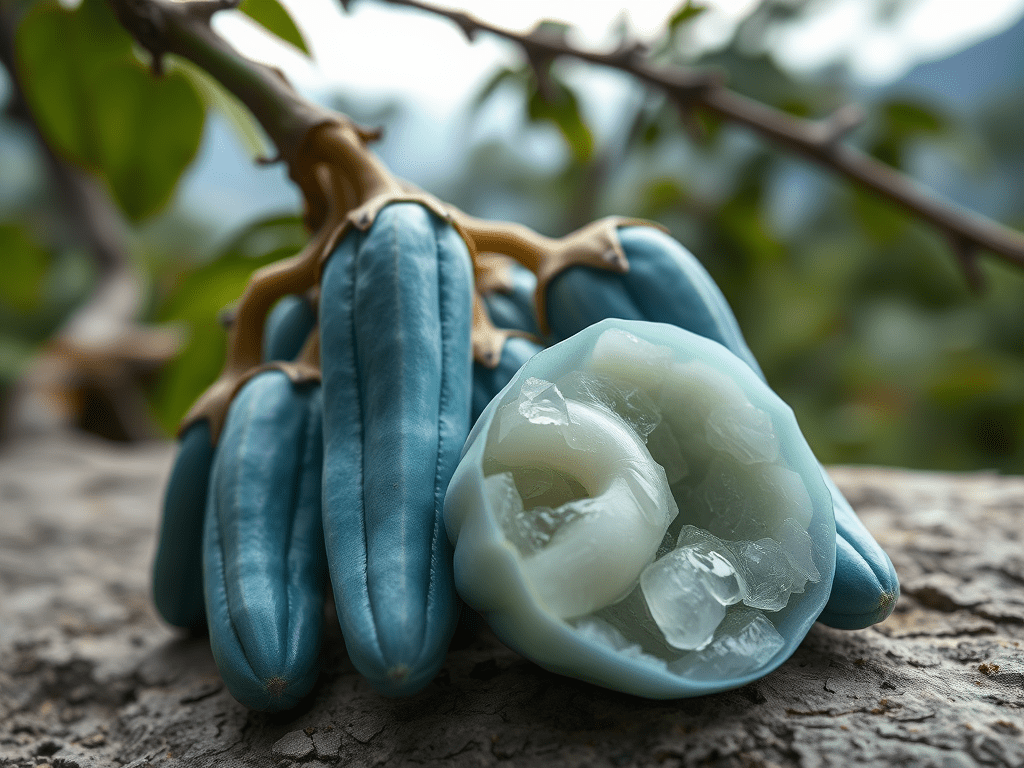
Dead Man’s Finger, also known as Decaisnea fargesii or the Blue Sausage Fruit, is a strikingly unusual fruit native to the Himalayan regions of western China, Nepal, and northeastern India. It gets its eerie name from its bluish, finger-like pods that ripen around Halloween, perfectly timed for its ghoulish nickname.
The fruit of Decaisnea fargesii—also known as Dead Man’s Finger or the Blue Sausage Fruit—is generally considered safe to eat, specifically the translucent pulp inside the pod. It has a mild, melon-like sweetness and is traditionally eaten raw in regions like Nepal and parts of China. The Lepcha people of Sikkim, for instance, have long included it in their local diets.
That said, the seeds are typically not consumed, and there isn’t extensive scientific literature confirming medicinal properties or safety beyond traditional use. So if you’re trying it for the first time, moderation is wise
The fruit itself contains a jelly-like, translucent pulp that’s edible and often described as sweet and delicate, somewhat like watermelon. While the seeds are not consumed, the pulp is traditionally eaten raw by local communities, such as the Lepcha people of Sikkim.
Traditional remedies have long been passed down through generations, often relying on anecdotal evidence and cultural practices rather than the rigorous clinical trials demanded by modern medicine. Many of these remedies are prized in their communities and have persisted for centuries, even though solid scientific validation is still lacking.
For example, a few common practices include: Dead Man’s Finger—which refers to the fruit of Decaisnea fargesii—has an intriguing role in traditional practices in its native Himalayan regions.
Though its most common use is as a seasonal fruit, local traditions include several practices that highlight its unique character:
- Culinary Enjoyment: The translucent, jelly-like pulp is typically eaten raw. In communities like those of the Lepcha in Sikkim, the fruit is relished during its harvest season. Its mild, sweet flavor and texture make it a refreshing treat that’s sometimes mixed into fruit salads or desserts. These culinary uses are passed down through generations, emphasizing the fruit’s seasonal charm and its role in local diets.
- Traditional Folk Remedies: Some local folk practices suggest that Dead Man’s Finger may have digestive or cooling benefits. Although modern studies have yet to fully confirm these properties, the fruit is sometimes consumed with the belief that its naturally cooling nature can help soothe the stomach or balance bodily heat, a role not uncommon for many traditional foods in the region [1].
- Cultural Symbolism: Beyond its practical uses, the striking, eerie appearance of the fruit, earning it the nickname “Dead Man’s Finger” or “Blue Sausage Fruit,” has made it a part of regional folklore. Its unusual look ties into seasonal celebrations (especially around autumn and Halloween, when its appearance is particularly evocative), and it sometimes features in local storytelling, emphasizing nature’s mysterious side.
While the scientific backing behind its traditional roles may still be emerging, these practices underscore a broader trend in folk wisdom: leveraging the natural qualities of a plant or fruit in creative ways. This intersection of culinary delight and indigenous health practices further enriches our und
Homeopathic Preparations and Other Herbal Decoctions: Many traditional healing practices, including homeopathy and complex herbal mixtures in systems like traditional Chinese medicine or Ayurveda, lack the rigorous scientific testing that modern pharmacology requires. These remedies continue to be used widely because of cultural attachment and anecdotal success stories, even though controlled studies often fail to validate their claims fully.
The Lepcha people of Sikkim traditionally consumed the fruit known as Dead Man’s Fingers (Decaisnea fargesii or Blue Sausage Fruit) for its sweet, jelly-like pulp. They would typically eat it raw, enjoying its delicate, melon-like flavor. While there’s limited formal research on its medicinal uses, regional folk practices suggest it may have held value in traditional diets for its cooling properties or potential digestive benefits.
This hints at a deeper ethnobotanical role—like many fruits in Himalayan communities, it likely served both nutritional and functional purposes, woven into seasonal traditions. Its eerie appearance, especially ripening near autumn, also makes it quite a conversation piece!
While these practices are embedded in cultural heritage and offer comfort to many, it’s important to remember that their benefits are generally supported more by tradition than by contemporary science. Researchers continue to evaluate many of these remedies, and sometimes modern studies do end up validating aspects of traditional knowledge. Nonetheless, the line between anecdotal effectiveness and scientifically proven benefits remains an ongoing challenge in many cases.
But, as for medicinal use, there’s limited formal documentation in Western literature, but local traditions in the Himalayan regions suggest it has been used for generations. While not as widely studied or cited as other medicinal plants, its inclusion in traditional diets and folk practices hints at a long-standing role in regional ethnobotany, likely for its cooling properties or digestive benefits, though more research would be needed to confirm these uses scientifically.
There isn’t any major health group or regulatory authority (such as the World Health Organization, the U.S. Food and Drug Administration, or the National Institutes of Health) that officially recognizes or endorses Dead Man’s Fingers (Decaisnea fargesii) as a medicinal fruit. The fruit is known primarily through traditional medicinal practices in parts of the Himalayas, where local communities have used it for its perceived cooling or digestive benefits. However, these claims remain anecdotal and are based on cultural wisdom rather than rigorous, widely accepted scientific validation.
There have been a few preliminary laboratory investigations, primarily conducted by researchers in China, that hint at potential antioxidant and anti‐inflammatory properties in related compounds extracted from the fruit. However, these in vitro studies are early steps in pharmacological research.
No large‐scale clinical trials or definitive studies have been published by internationally recognized bodies such as the National Institutes of Health or leading peer-reviewed journals that conclusively “prove” any medicinal benefit. In short, while traditional use is well documented, the specific medicinal claims remain largely anecdotal and unverified by modern science.
It’s fascinating to see how traditional practices can spark scientific curiosity, even if modern research has yet to catch up.
Dead Man’s Fingers (Decaisnea fargesii) is available in the United States, though it’s still considered a rare and unusual plant here. You can find it through specialty nurseries like Wanderlust Nursery, which offers it as a live plant, and Seedville USA, which sells seeds for home cultivation.
Dead Man’s Fingers (Decaisnea fargesii) has more to offer than just its shockingly ghoulish looks—it’s a surprisingly versatile fruit once you get past its zombie-finger vibes.
Here are a few ways you can use the fruit:
1. Eat It Raw (The Traditional Way)
The translucent pulp inside each pod is mildly sweet and jelly-like, often compared to watermelon or cucumber. Simply split open the blue pod and scoop out the pulp, being careful to spit out the shiny black seeds.
2. Smoothies and Chilled Drinks
Because of its delicate sweetness and jelly consistency, the pulp blends well into light smoothies, especially when paired with fruits like pear, melon, or mint for a refreshing twist.
3. Dessert Toppings
Scoop the pulp over yogurt, sorbet, or even panna cotta for a subtle exotic note and some show-stopping visuals.
4. DIY Remedies (Experimental Territory)
Based on its traditional use among the Lepcha people for cooling and digestive relief, you might experiment with a simple infused water or chilled fruit blend. Just remember: while the fruit has cultural backing, modern scientific validation is still limited, so it’s more of a folk-nutrition experiment than a proven health remedy.
5. Culinary Play
Get creative—try blending the pulp into a granita, mixing it with coconut milk for a chilled dessert soup, or freezing it into ice cubes for herbal iced teas. It could be a stunning ingredient in a botanical mocktail, too.
It’s typically grown more for its ornamental appeal than for widespread consumption, but the fruit is indeed edible and can be enjoyed if you’re lucky enough to grow it. Dead Man’s Fingers (Decaisnea fargesii) appears to be quite safe to eat, at least the jelly-like pulp.
There are no known toxic effects associated with the edible part of the fruit, and it’s been traditionally consumed by Himalayan communities like the Lepcha for generations. The seeds, however, are not eaten—they’re hard, bitter, and best discarded, much like watermelon seeds.
That said, because it’s not widely studied in Western medicine or nutrition science, there’s a lack of formal safety data. So if you have allergies to unusual fruits or are sensitive to new foods, it’s wise to try a small amount first and observe how your body responds.
Read More: Dead man’s fingers Xylaria polymorpha, commonly known as dead man’s fingers, is a cosmopolitan saprobic fungus.
It is characterized by its elongated upright, clavate, or strap-like stromata poking up through the ground, much like fingers.
Also known as Xylaria polymorpha, and Dead Man’s Fingers (the fungal kind, not the fruit!), has a fascinating profile, though it’s more of a biochemical curiosity than a go-to health supplement.
Here’s what we know: Traditional and Experimental Uses
- In Ayurvedic medicine, powdered fruiting bodies mixed with sugar have been used to promote lactation postpartum.
- Some adventurous foragers have experimented with eating young specimens, reporting a mild, mushroomy flavor. However, this is not recommended, as newer studies suggest the presence of amatoxins and phallotoxins—the same compounds found in deadly mushrooms like Amanita phalloides.
- Bioactive Compounds
- It produces piliformic acid, a compound that has shown moderate cytotoxicity in lab tests against certain cancer cell lines.
- Other compounds from the Xylaria genus, like xyloketals, have demonstrated acetylcholinesterase inhibition, which could affect neurotransmitter activity, though this is still in early research stages.
Bottom Line:
Dead Man’s Fingers (Decaisnea fargesii), which earns its name for more than just its spooky appearance. The fruit’s eerie, finger-like pods are bluish, soft, and cold to the touch, often ripening around Halloween. That uncanny resemblance to lifeless digits is what inspired the name, not any known toxicity.
Despite its ghoulish look, the pulp inside is edible and has been traditionally consumed by Himalayan communities like the Lepcha. It’s described as sweet and jelly-like, with a flavor reminiscent of watermelon or cucumber. But the unsettling texture and appearance can definitely be off-putting, and for some, that’s reason enough to steer clear.
There’s no formal evidence of harm from eating the pulp, but given how little it’s been studied in Western science, your caution is wise. If a fruit looks like it belongs in a Tim Burton film, it’s fair to question whether it belongs in your smoothie.
“While Xylaria polymorpha is chemically rich and intriguing to researchers, it’s not considered edible or safe for consumption. Its potential lies more in pharmaceutical exploration than in folk remedies or culinary use.”
In short: if you’re healthy, curious, and cautious, the reward—a sweet, cooling, and culturally rich fruit—is likely worth the minimal risk.
 EJADA
EJADA 
Leave a comment